Three facts set it, and each is on the page rather than in somebody’s judgement. Almost the whole line is built in and panel-ready, so access is a measurable part of the visit. The parts channel after 2016 is a real, high-volume one rather than a hand-built European supply, which holds the component figures down. And the legacy era is genuinely a different machine, with parts that are quoted rather than published.
45 jobs priced · every figure a from
What a Dacor repair costs, and what moves the number.
Every figure here is a starting point, and each page names three specific things that push that job up or down. Two of them recur across the whole site: whether the appliance is captured by cabinetry, and which side of 2016 it was built.
- 45 jobs with a published figure
- from $95 diagnostic, credited to the repair
- Every one is a from, never a final price
- 3 factors named on every page
Every job with a figure
All 45 of them
Each page names three specific things that move that particular number.
-
Diagnostic visit cost
What diagnostic visit costs on a Dacor in South Florida, from $95, and what moves that figure up or down. No final price is published anywhere on this site: the exact cost is confirmed on site after the diagnostic and agreed in writing before anything is opened.
- from $95, and the three things that move it
- Access and the era are quoted separately — both change the hour before the part does
- Confirmed on site in writing, and we say when a repair is not worth doing
-
Appliance maintenance cost
What appliance maintenance costs on a Dacor in South Florida, from $165, and what moves that figure up or down. No final price is published anywhere on this site: the exact cost is confirmed on site after the diagnostic and agreed in writing before anything is opened.
- from $165, and the three things that move it
- Access and the era are quoted separately — both change the hour before the part does
- Confirmed on site in writing, and we say when a repair is not worth doing
-
Appliance installation cost
What appliance installation costs on a Dacor in South Florida, from $225, and what moves that figure up or down. No final price is published anywhere on this site: the exact cost is confirmed on site after the diagnostic and agreed in writing before anything is opened.
- from $225, and the three things that move it
- Access and the era are quoted separately — both change the hour before the part does
- Confirmed on site in writing, and we say when a repair is not worth doing
-
Control board repair cost
What control board repair costs on a Dacor in South Florida, from $295, and what moves that figure up or down. No final price is published anywhere on this site: the exact cost is confirmed on site after the diagnostic and agreed in writing before anything is opened.
- from $295, and the three things that move it
- Access and the era are quoted separately — both change the hour before the part does
- Confirmed on site in writing, and we say when a repair is not worth doing
-
Refrigerator not cooling repair cost
What refrigerator not cooling repair costs on a Dacor in South Florida, from $185, and what moves that figure up or down. No final price is published anywhere on this site: the exact cost is confirmed on site after the diagnostic and agreed in writing before anything is opened.
- from $185, and the three things that move it
- Access and the era are quoted separately — both change the hour before the part does
- Confirmed on site in writing, and we say when a repair is not worth doing
-
Built-in column access cost
What built-in column access costs on a Dacor in South Florida, from $185, and what moves that figure up or down. No final price is published anywhere on this site: the exact cost is confirmed on site after the diagnostic and agreed in writing before anything is opened.
- from $185, and the three things that move it
- Access and the era are quoted separately — both change the hour before the part does
- Confirmed on site in writing, and we say when a repair is not worth doing
-
Defrost system repair cost
What defrost system repair costs on a Dacor in South Florida, from $175, and what moves that figure up or down. No final price is published anywhere on this site: the exact cost is confirmed on site after the diagnostic and agreed in writing before anything is opened.
- from $175, and the three things that move it
- Access and the era are quoted separately — both change the hour before the part does
- Confirmed on site in writing, and we say when a repair is not worth doing
-
Evaporator fan repair cost
What evaporator fan repair costs on a Dacor in South Florida, from $159, and what moves that figure up or down. No final price is published anywhere on this site: the exact cost is confirmed on site after the diagnostic and agreed in writing before anything is opened.
- from $159, and the three things that move it
- Access and the era are quoted separately — both change the hour before the part does
- Confirmed on site in writing, and we say when a repair is not worth doing
-
Condenser cleaning cost
What condenser cleaning costs on a Dacor in South Florida, from $129, and what moves that figure up or down. No final price is published anywhere on this site: the exact cost is confirmed on site after the diagnostic and agreed in writing before anything is opened.
- from $129, and the three things that move it
- Access and the era are quoted separately — both change the hour before the part does
- Confirmed on site in writing, and we say when a repair is not worth doing
-
Door seal replacement cost
What door seal replacement costs on a Dacor in South Florida, from $165, and what moves that figure up or down. No final price is published anywhere on this site: the exact cost is confirmed on site after the diagnostic and agreed in writing before anything is opened.
- from $165, and the three things that move it
- Access and the era are quoted separately — both change the hour before the part does
- Confirmed on site in writing, and we say when a repair is not worth doing
-
Refrigerator leak repair cost
What refrigerator leak repair costs on a Dacor in South Florida, from $155, and what moves that figure up or down. No final price is published anywhere on this site: the exact cost is confirmed on site after the diagnostic and agreed in writing before anything is opened.
- from $155, and the three things that move it
- Access and the era are quoted separately — both change the hour before the part does
- Confirmed on site in writing, and we say when a repair is not worth doing
-
Freezer column repair cost
What freezer column repair costs on a Dacor in South Florida, from $185, and what moves that figure up or down. No final price is published anywhere on this site: the exact cost is confirmed on site after the diagnostic and agreed in writing before anything is opened.
- from $185, and the three things that move it
- Access and the era are quoted separately — both change the hour before the part does
- Confirmed on site in writing, and we say when a repair is not worth doing
-
Ice maker repair cost
What ice maker repair costs on a Dacor in South Florida, from $165, and what moves that figure up or down. No final price is published anywhere on this site: the exact cost is confirmed on site after the diagnostic and agreed in writing before anything is opened.
- from $165, and the three things that move it
- Access and the era are quoted separately — both change the hour before the part does
- Confirmed on site in writing, and we say when a repair is not worth doing
-
Water line and fill valve service cost
What water line and fill valve service costs on a Dacor in South Florida, from $139, and what moves that figure up or down. No final price is published anywhere on this site: the exact cost is confirmed on site after the diagnostic and agreed in writing before anything is opened.
- from $139, and the three things that move it
- Access and the era are quoted separately — both change the hour before the part does
- Confirmed on site in writing, and we say when a repair is not worth doing
-
Wine column not cooling repair cost
What wine column not cooling repair costs on a Dacor in South Florida, from $185, and what moves that figure up or down. No final price is published anywhere on this site: the exact cost is confirmed on site after the diagnostic and agreed in writing before anything is opened.
- from $185, and the three things that move it
- Access and the era are quoted separately — both change the hour before the part does
- Confirmed on site in writing, and we say when a repair is not worth doing
-
Wine zone calibration cost
What wine zone calibration costs on a Dacor in South Florida, from $165, and what moves that figure up or down. No final price is published anywhere on this site: the exact cost is confirmed on site after the diagnostic and agreed in writing before anything is opened.
- from $165, and the three things that move it
- Access and the era are quoted separately — both change the hour before the part does
- Confirmed on site in writing, and we say when a repair is not worth doing
-
Wine door and seal service cost
What wine door and seal service costs on a Dacor in South Florida, from $149, and what moves that figure up or down. No final price is published anywhere on this site: the exact cost is confirmed on site after the diagnostic and agreed in writing before anything is opened.
- from $149, and the three things that move it
- Access and the era are quoted separately — both change the hour before the part does
- Confirmed on site in writing, and we say when a repair is not worth doing
-
Glideracks and runner service cost
What glideracks and runner service costs on a Dacor in South Florida, from $119, and what moves that figure up or down. No final price is published anywhere on this site: the exact cost is confirmed on site after the diagnostic and agreed in writing before anything is opened.
- from $119, and the three things that move it
- Access and the era are quoted separately — both change the hour before the part does
- Confirmed on site in writing, and we say when a repair is not worth doing
-
Dishwasher drain and pump repair cost
What dishwasher drain and pump repair costs on a Dacor in South Florida, from $165, and what moves that figure up or down. No final price is published anywhere on this site: the exact cost is confirmed on site after the diagnostic and agreed in writing before anything is opened.
- from $165, and the three things that move it
- Access and the era are quoted separately — both change the hour before the part does
- Confirmed on site in writing, and we say when a repair is not worth doing
-
Dishwasher leak repair cost
What dishwasher leak repair costs on a Dacor in South Florida, from $159, and what moves that figure up or down. No final price is published anywhere on this site: the exact cost is confirmed on site after the diagnostic and agreed in writing before anything is opened.
- from $159, and the three things that move it
- Access and the era are quoted separately — both change the hour before the part does
- Confirmed on site in writing, and we say when a repair is not worth doing
-
Wash performance service cost
What wash performance service costs on a Dacor in South Florida, from $139, and what moves that figure up or down. No final price is published anywhere on this site: the exact cost is confirmed on site after the diagnostic and agreed in writing before anything is opened.
- from $139, and the three things that move it
- Access and the era are quoted separately — both change the hour before the part does
- Confirmed on site in writing, and we say when a repair is not worth doing
-
Door, latch and AutoRelease repair cost
What door, latch and AutoRelease repair costs on a Dacor in South Florida, from $135, and what moves that figure up or down. No final price is published anywhere on this site: the exact cost is confirmed on site after the diagnostic and agreed in writing before anything is opened.
- from $135, and the three things that move it
- Access and the era are quoted separately — both change the hour before the part does
- Confirmed on site in writing, and we say when a repair is not worth doing
-
Drying and heat repair cost
What drying and heat repair costs on a Dacor in South Florida, from $155, and what moves that figure up or down. No final price is published anywhere on this site: the exact cost is confirmed on site after the diagnostic and agreed in writing before anything is opened.
- from $155, and the three things that move it
- Access and the era are quoted separately — both change the hour before the part does
- Confirmed on site in writing, and we say when a repair is not worth doing
-
Built-in water softener service cost
What built-in water softener service costs on a Dacor in South Florida, from $129, and what moves that figure up or down. No final price is published anywhere on this site: the exact cost is confirmed on site after the diagnostic and agreed in writing before anything is opened.
- from $129, and the three things that move it
- Access and the era are quoted separately — both change the hour before the part does
- Confirmed on site in writing, and we say when a repair is not worth doing
-
Oven not heating cost
What oven not heating costs on a Dacor in South Florida, from $175, and what moves that figure up or down. No final price is published anywhere on this site: the exact cost is confirmed on site after the diagnostic and agreed in writing before anything is opened.
- from $175, and the three things that move it
- Access and the era are quoted separately — both change the hour before the part does
- Confirmed on site in writing, and we say when a repair is not worth doing
-
Temperature sensor and calibration cost
What temperature sensor and calibration costs on a Dacor in South Florida, from $149, and what moves that figure up or down. No final price is published anywhere on this site: the exact cost is confirmed on site after the diagnostic and agreed in writing before anything is opened.
- from $149, and the three things that move it
- Access and the era are quoted separately — both change the hour before the part does
- Confirmed on site in writing, and we say when a repair is not worth doing
-
Steam oven water system cost
What steam oven water system costs on a Dacor in South Florida, from $175, and what moves that figure up or down. No final price is published anywhere on this site: the exact cost is confirmed on site after the diagnostic and agreed in writing before anything is opened.
- from $175, and the three things that move it
- Access and the era are quoted separately — both change the hour before the part does
- Confirmed on site in writing, and we say when a repair is not worth doing
-
Oven door and hinge repair cost
What oven door and hinge repair costs on a Dacor in South Florida, from $169, and what moves that figure up or down. No final price is published anywhere on this site: the exact cost is confirmed on site after the diagnostic and agreed in writing before anything is opened.
- from $169, and the three things that move it
- Access and the era are quoted separately — both change the hour before the part does
- Confirmed on site in writing, and we say when a repair is not worth doing
-
Self-clean and door lock repair cost
What self-clean and door lock repair costs on a Dacor in South Florida, from $175, and what moves that figure up or down. No final price is published anywhere on this site: the exact cost is confirmed on site after the diagnostic and agreed in writing before anything is opened.
- from $175, and the three things that move it
- Access and the era are quoted separately — both change the hour before the part does
- Confirmed on site in writing, and we say when a repair is not worth doing
-
Gas burner and igniter repair cost
What gas burner and igniter repair costs on a Dacor in South Florida, from $155, and what moves that figure up or down. No final price is published anywhere on this site: the exact cost is confirmed on site after the diagnostic and agreed in writing before anything is opened.
- from $155, and the three things that move it
- Access and the era are quoted separately — both change the hour before the part does
- Confirmed on site in writing, and we say when a repair is not worth doing
-
Rangetop service cost
What rangetop service costs on a Dacor in South Florida, from $195, and what moves that figure up or down. No final price is published anywhere on this site: the exact cost is confirmed on site after the diagnostic and agreed in writing before anything is opened.
- from $195, and the three things that move it
- Access and the era are quoted separately — both change the hour before the part does
- Confirmed on site in writing, and we say when a repair is not worth doing
-
Integrated griddle service cost
What integrated griddle service costs on a Dacor in South Florida, from $159, and what moves that figure up or down. No final price is published anywhere on this site: the exact cost is confirmed on site after the diagnostic and agreed in writing before anything is opened.
- from $159, and the three things that move it
- Access and the era are quoted separately — both change the hour before the part does
- Confirmed on site in writing, and we say when a repair is not worth doing
-
Induction cooktop repair cost
What induction cooktop repair costs on a Dacor in South Florida, from $205, and what moves that figure up or down. No final price is published anywhere on this site: the exact cost is confirmed on site after the diagnostic and agreed in writing before anything is opened.
- from $205, and the three things that move it
- Access and the era are quoted separately — both change the hour before the part does
- Confirmed on site in writing, and we say when a repair is not worth doing
-
Cooktop glass replacement cost
What cooktop glass replacement costs on a Dacor in South Florida, from $275, and what moves that figure up or down. No final price is published anywhere on this site: the exact cost is confirmed on site after the diagnostic and agreed in writing before anything is opened.
- from $275, and the three things that move it
- Access and the era are quoted separately — both change the hour before the part does
- Confirmed on site in writing, and we say when a repair is not worth doing
-
Legacy control diagnosis cost
What legacy control diagnosis costs on a Dacor in South Florida, from $125, and what moves that figure up or down. No final price is published anywhere on this site: the exact cost is confirmed on site after the diagnostic and agreed in writing before anything is opened.
- from $125, and the three things that move it
- Access and the era are quoted separately — both change the hour before the part does
- Confirmed on site in writing, and we say when a repair is not worth doing
-
Hood motor and blower service cost
What hood motor and blower service costs on a Dacor in South Florida, from $165, and what moves that figure up or down. No final price is published anywhere on this site: the exact cost is confirmed on site after the diagnostic and agreed in writing before anything is opened.
- from $165, and the three things that move it
- Access and the era are quoted separately — both change the hour before the part does
- Confirmed on site in writing, and we say when a repair is not worth doing
-
Hood liner service cost
What hood liner service costs on a Dacor in South Florida, from $175, and what moves that figure up or down. No final price is published anywhere on this site: the exact cost is confirmed on site after the diagnostic and agreed in writing before anything is opened.
- from $175, and the three things that move it
- Access and the era are quoted separately — both change the hour before the part does
- Confirmed on site in writing, and we say when a repair is not worth doing
-
Hood light and control service cost
What hood light and control service costs on a Dacor in South Florida, from $119, and what moves that figure up or down. No final price is published anywhere on this site: the exact cost is confirmed on site after the diagnostic and agreed in writing before anything is opened.
- from $119, and the three things that move it
- Access and the era are quoted separately — both change the hour before the part does
- Confirmed on site in writing, and we say when a repair is not worth doing
-
Built-in microwave repair cost
What built-in microwave repair costs on a Dacor in South Florida, from $195, and what moves that figure up or down. No final price is published anywhere on this site: the exact cost is confirmed on site after the diagnostic and agreed in writing before anything is opened.
- from $195, and the three things that move it
- Access and the era are quoted separately — both change the hour before the part does
- Confirmed on site in writing, and we say when a repair is not worth doing
-
Microwave drawer mechanism cost
What microwave drawer mechanism costs on a Dacor in South Florida, from $185, and what moves that figure up or down. No final price is published anywhere on this site: the exact cost is confirmed on site after the diagnostic and agreed in writing before anything is opened.
- from $185, and the three things that move it
- Access and the era are quoted separately — both change the hour before the part does
- Confirmed on site in writing, and we say when a repair is not worth doing
-
Over-range microwave and vent service cost
What over-range microwave and vent service costs on a Dacor in South Florida, from $169, and what moves that figure up or down. No final price is published anywhere on this site: the exact cost is confirmed on site after the diagnostic and agreed in writing before anything is opened.
- from $169, and the three things that move it
- Access and the era are quoted separately — both change the hour before the part does
- Confirmed on site in writing, and we say when a repair is not worth doing
-
Coffee system brew group service cost
What coffee system brew group service costs on a Dacor in South Florida, from $185, and what moves that figure up or down. No final price is published anywhere on this site: the exact cost is confirmed on site after the diagnostic and agreed in writing before anything is opened.
- from $185, and the three things that move it
- Access and the era are quoted separately — both change the hour before the part does
- Confirmed on site in writing, and we say when a repair is not worth doing
-
Coffee system descaling and water cost
What coffee system descaling and water costs on a Dacor in South Florida, from $145, and what moves that figure up or down. No final price is published anywhere on this site: the exact cost is confirmed on site after the diagnostic and agreed in writing before anything is opened.
- from $145, and the three things that move it
- Access and the era are quoted separately — both change the hour before the part does
- Confirmed on site in writing, and we say when a repair is not worth doing
-
Rental turnaround service cost
What rental turnaround service costs on a Dacor in South Florida, from $175, and what moves that figure up or down. No final price is published anywhere on this site: the exact cost is confirmed on site after the diagnostic and agreed in writing before anything is opened.
- from $175, and the three things that move it
- Access and the era are quoted separately — both change the hour before the part does
- Confirmed on site in writing, and we say when a repair is not worth doing
-
Smart features and connectivity cost
What smart features and connectivity costs on a Dacor in South Florida, from $109, and what moves that figure up or down. No final price is published anywhere on this site: the exact cost is confirmed on site after the diagnostic and agreed in writing before anything is opened.
- from $109, and the three things that move it
- Access and the era are quoted separately — both change the hour before the part does
- Confirmed on site in writing, and we say when a repair is not worth doing
Where this band sits
Between the luxury built-ins and the hand-built ranges
See what each job involves
The rule that never moves
No final price is published anywhere on this site
The same job is not the same work on two appliances. A column in a trim kit and a freestanding cabinet are hours apart before anything is unscrewed, and a pre-2016 board and a current one are different parts at different prices. The exact cost is measured at your appliance and agreed in writing before anything is opened.
Before you book
What changes the figure most
Tells us the hour
- Whether the appliance is panel-ready and how it is held in.
- Whether a column has to be brought forward at all.
- Whether several appliances can be seen in the same visit.
Tells us the part
- The model and serial, which settle the era.
- What the display says, exactly.
- Whether a legacy part is involved, so availability can be checked first.
Or read what the job involves
By repair instead
Each service page describes the work itself, step by step.
-
from $95 Diagnostic visit
Finding out what has actually gone wrong, before any part is named or priced. On this badge two questions come before the problem itself: how old the kitchen is, and how the appliance is held. The age decides which problem language the machine speaks — the pre-2016 boards and their F-codes, or the current platform and its letter codes — and the two share nothing. How it is held decides how long it takes to reach. The charge is credited against the repair if you go ahead, and if our honest recommendation is that the machine is not worth mending, you still get that recommendation and the charge does not change.
- The era comes first — it decides the code table, the board and the part number
- A written figure ahead of the work, credited against the repair
- If mending it is the wrong call we say so, rather than selling a part
-
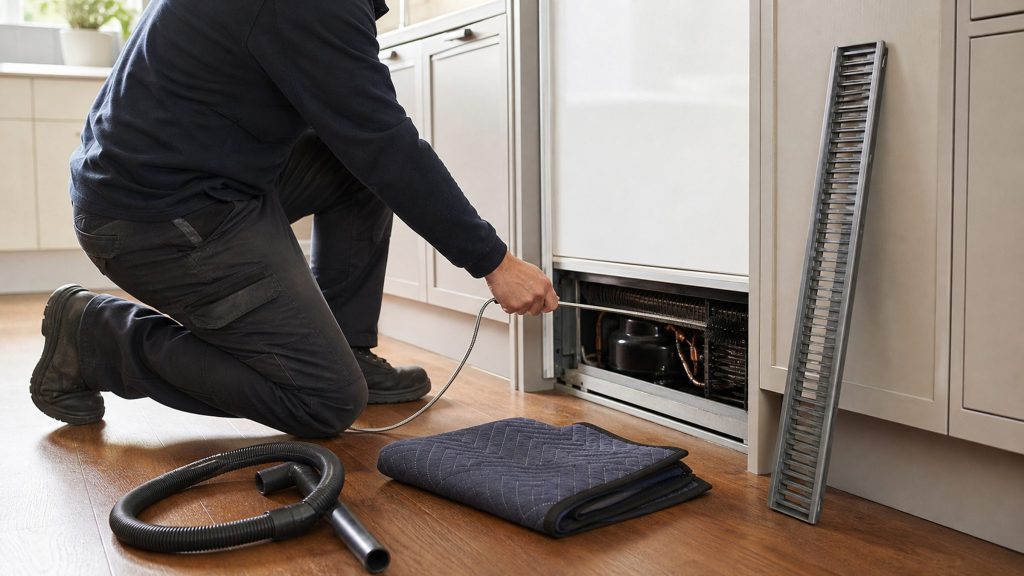
from $165 Appliance maintenance
The visit that keeps a built-in kitchen out of trouble, which on this make is mostly about air and water. Columns and panel-ready cabinets breathe through grilles that joinery and rugs slowly cover; the dishwasher softens its own water and that softener has a service interval; a steam oven has a reservoir and a descaling cycle; a hood liner fills with grease where nobody can see it. None of that is dramatic and all of it is cheaper than the failure it prevents. We do the lot in one visit rather than returning for each.
- Air paths first: column grilles, condenser coils, hood filters and blower
- Water next: the dishwasher softener, the steam reservoir, the coffee system's path
- One visit across the kitchen, not one visit per appliance
-
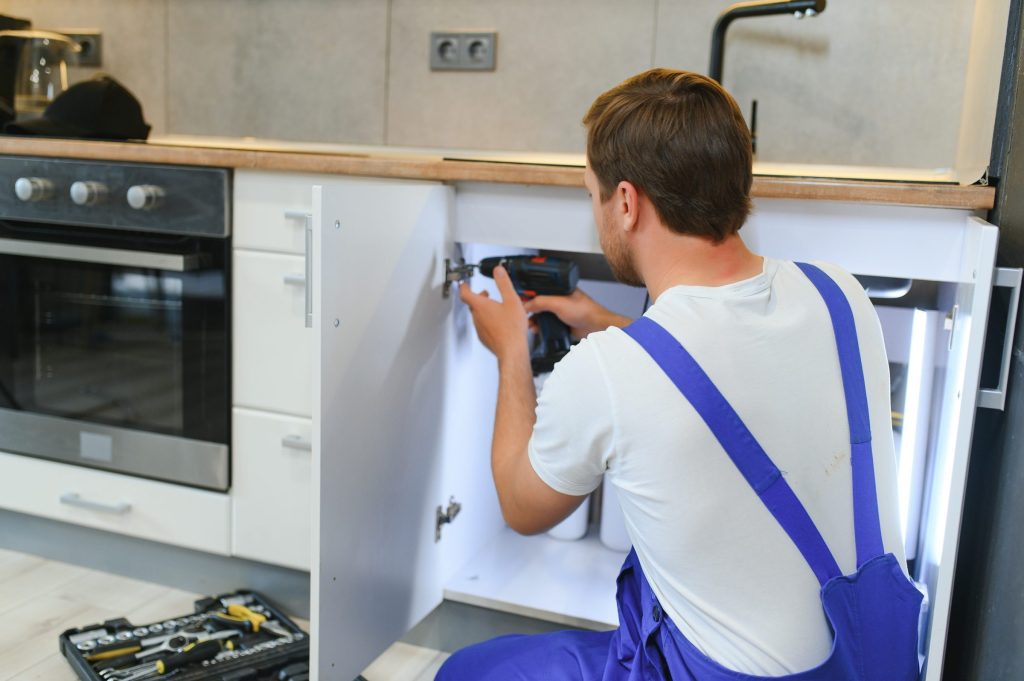
from $225 Appliance installation
Fitting equipment that was designed to disappear into cabinetry, which is a joinery job as much as a connection. Panel-ready columns and French doors take cabinet fronts and their hardware; wall ovens sit in tall units cut to a size; hood liners hide inside millwork built by somebody else; a rangetop drops into a worktop that has to be right before the appliance arrives. We measure the opening before delivery rather than after, because a cabinet that is a quarter inch out is a carpentry problem discovered on the wrong day.
- The opening is measured before the appliance is delivered, not on the day
- Panels, trim kits and handles fitted so the doors sit square and stay square
- Air path, water feed and power checked as part of the fit, not as an extra
-
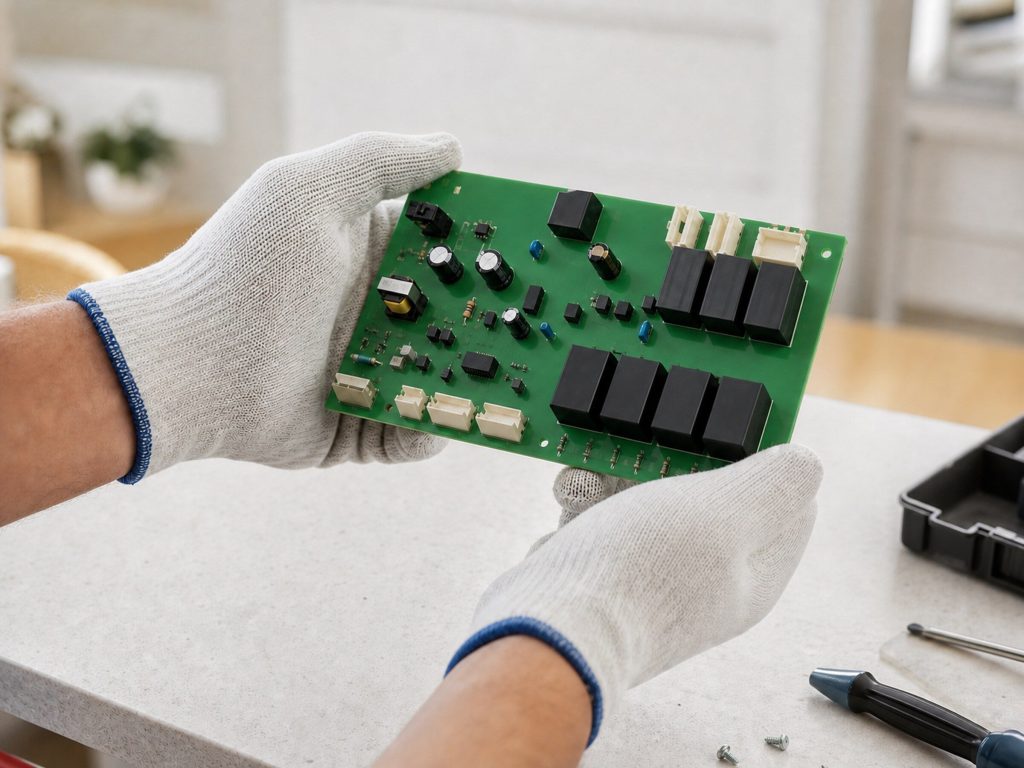
from $295 Control board repair
The board is the part most often blamed and least often at problem, so it is the last thing we conclude rather than the first. What makes this badge different is that there are two entirely separate generations of board behind the same door: the pre-2016 Dacor boards, and the Samsung-platform boards that replaced them. They are not interchangeable, the part numbers do not translate, and a supplier who is given the wrong one will happily sell it. We identify the generation from the plate before anything is ordered.
- Ruled in by elimination — sensors, harnesses and supply are checked first
- Two generations of board on one badge: the part numbers do not translate
- Legacy boards are quoted rather than published — availability is checked first
-
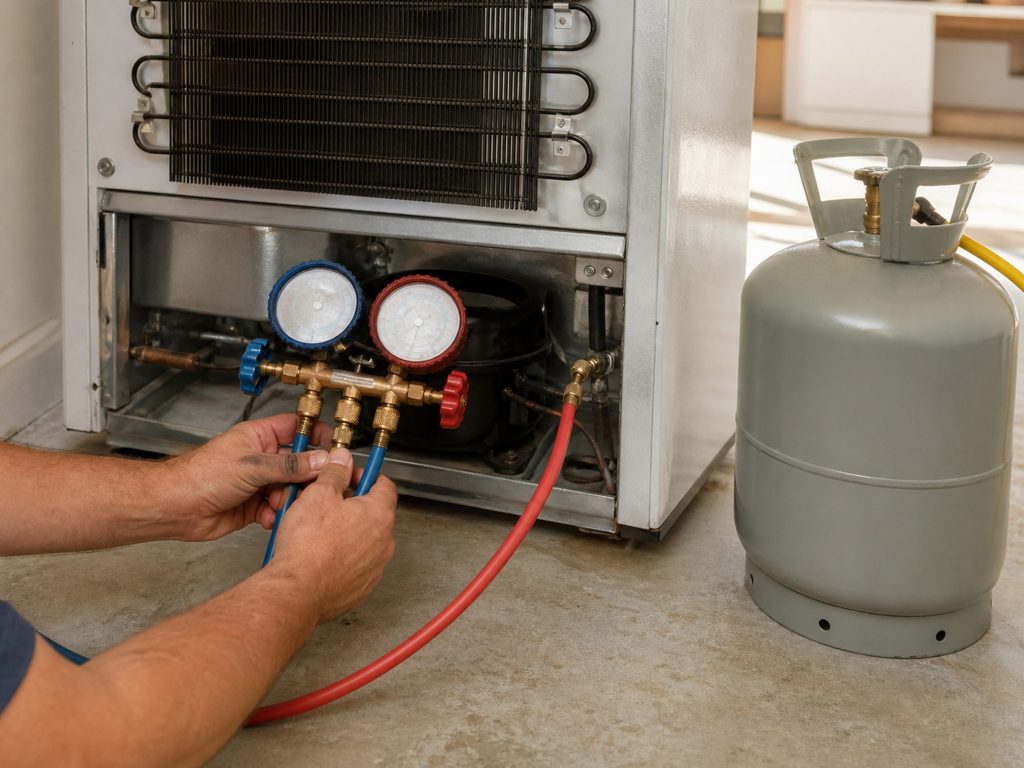
from $185 Refrigerator not cooling repair
The call that covers four quite different problems, and the first job is to find out which one. On a French-door cabinet a single warm compartment nearly always means the air path — defrost, a duct, a damper, the evaporator fan — because one sealed system serves both sides. On a column it means the opposite: two cabinets, two systems, and the cold one standing beside it is evidence. Before any of that, the grille: a panel-ready cabinet that cannot breathe produces every symptom of a dying compressor while being perfectly healthy.
- The air path before the sealed system — and the grille before both
- French door and column are different diagnoses, not the same one twice
- The cold cabinet next to the warm one is evidence, and we use it
-
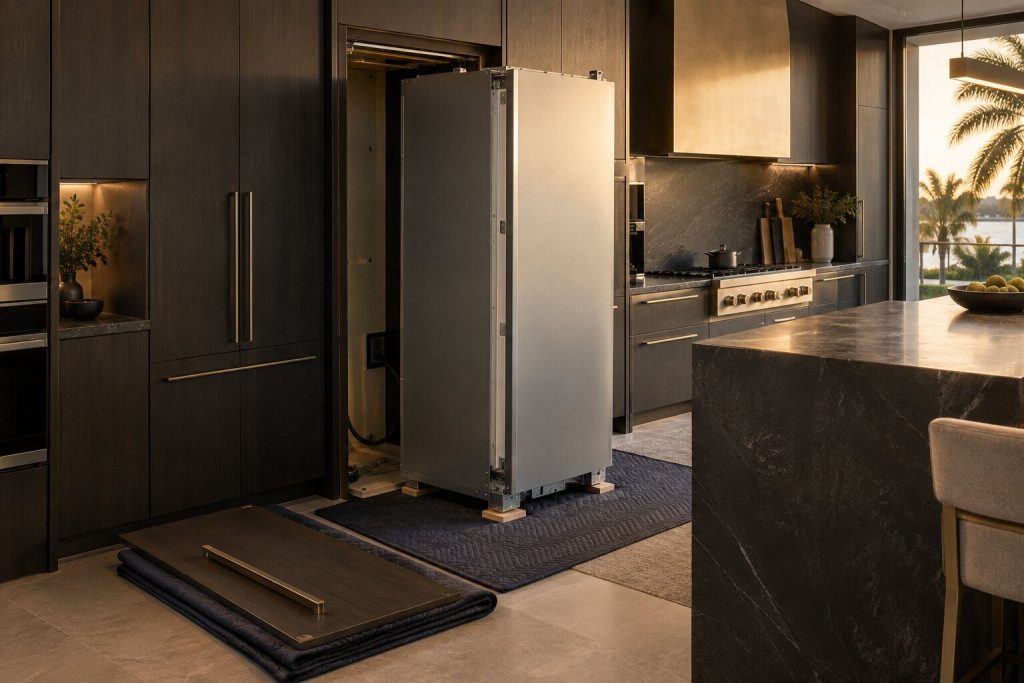
from $185 Built-in column access
The service that exists because of the shape of this line. A refrigeration column is captured by the cabinetry around it, held by trim, carrying a cabinet panel and a handle that belong to the kitchen rather than the appliance. Bringing it far enough forward to be worked on — and putting the joinery back exactly as it was — is real work with a real risk attached, and pretending otherwise is how a repair leaves a scratch down a walnut run. We price it as its own step so that nobody is surprised by it halfway through a visit.
- Panel, handle and trim removed and recorded before anything is moved
- The joinery is protected first — the risk here is the cabinetry, not the appliance
- Priced as its own step so it is never a surprise mid-visit
-
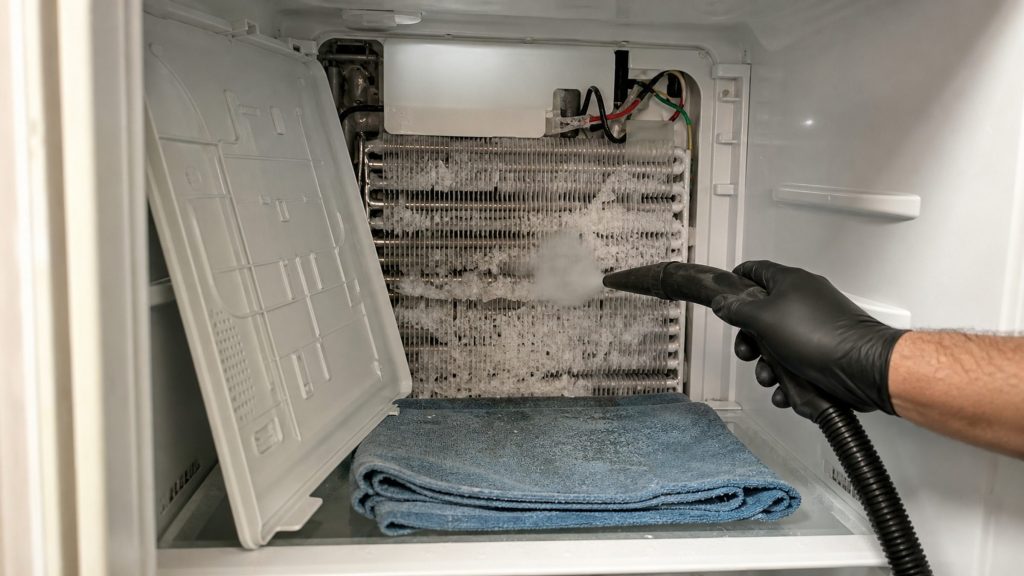
from $175 Defrost system repair
Frost where there should be none is a system problem rather than a mystery: a heater, a sensor, a thermostat and the control that decides when to run them. On these cabinets the symptom arrives slowly — a compartment that drifts a couple of degrees, then a fan that sounds like it is scraping, then ice visible at the back wall — and the cheapest moment to catch it is the first of those. On a column the whole load lives in one cabinet, so the same failure empties a freezer that a French door would have carried through.
- Heater, sensor, thermostat and the control that times them — checked as a system
- The early symptom is a two-degree drift, not visible ice
- On a column there is no second compartment to carry the load
-
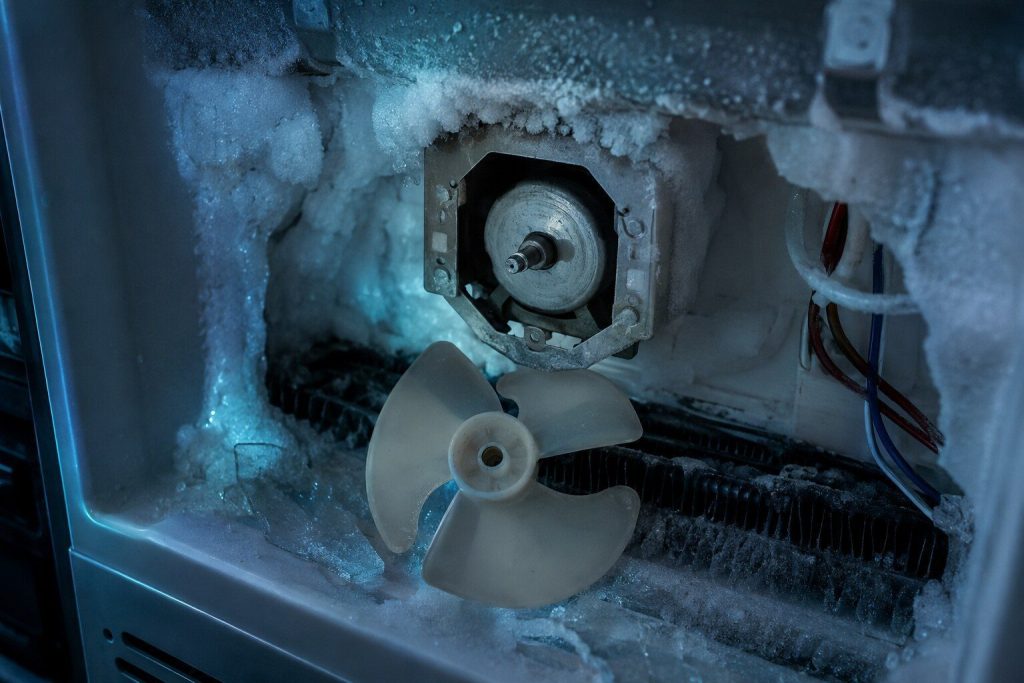
from $159 Evaporator fan repair
The fan that moves cold air is the part that most often explains a cabinet cooling unevenly. When it slows, stalls or is caught by ice, one compartment keeps its temperature and the other drifts, which reads as a refrigeration failure and is not one. It usually announces itself first as noise — a hum that rises with the door closed, a click, a scrape — and people reasonably wait for it to become worse. On a panel-ready cabinet it is worth not waiting: the fan is behind the back panel, and the visit is short while the cabinet is still cold.
- Uneven cooling with a healthy compressor is usually this
- Noise that changes with the door closed is the early warning
- Short visit while the cabinet still works — longer once it does not
-
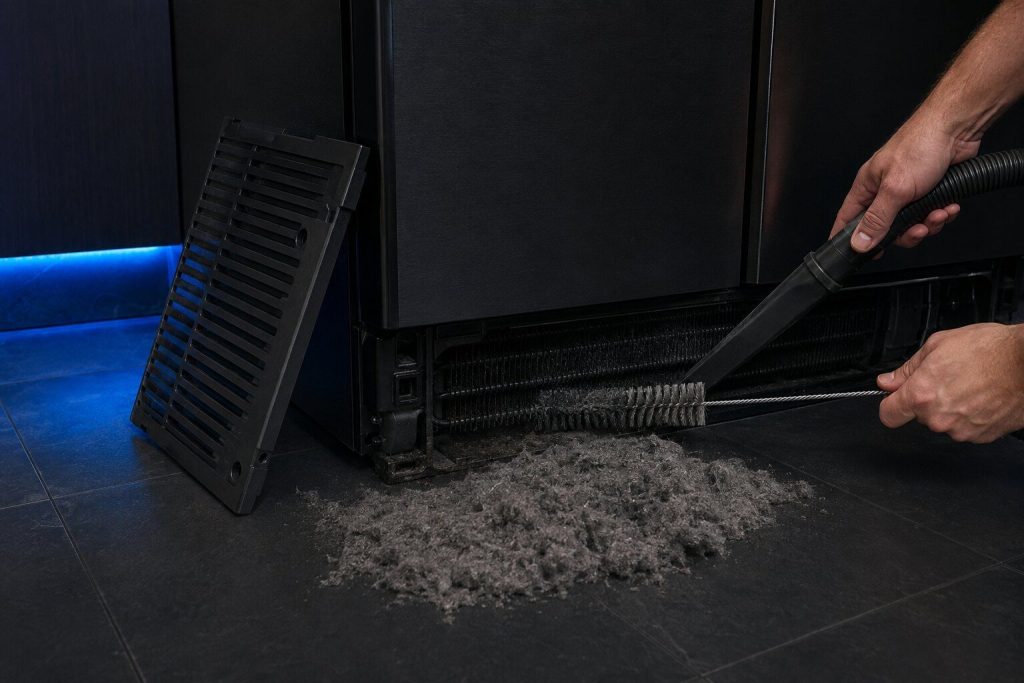
from $129 Condenser cleaning
The least glamorous visit on the list and the one that prevents the most expensive ones. A condenser rejects heat, and in a Miami kitchen it does that through a grille that collects dust, cooking grease and pet hair until the cabinet is running against itself. On built-in refrigeration it matters more than on freestanding, because the coil sits in a defined air path that the cabinetry controls: when that path is restricted, the compressor runs longer, the temperature drifts, and everything downstream ages faster than it should.
- Built-in refrigeration lives on a defined air path — restrict it and everything ages
- Grease and pet hair, not dust, are what actually block a Miami coil
- Cheapest visit here, and the one that prevents the dear ones
-
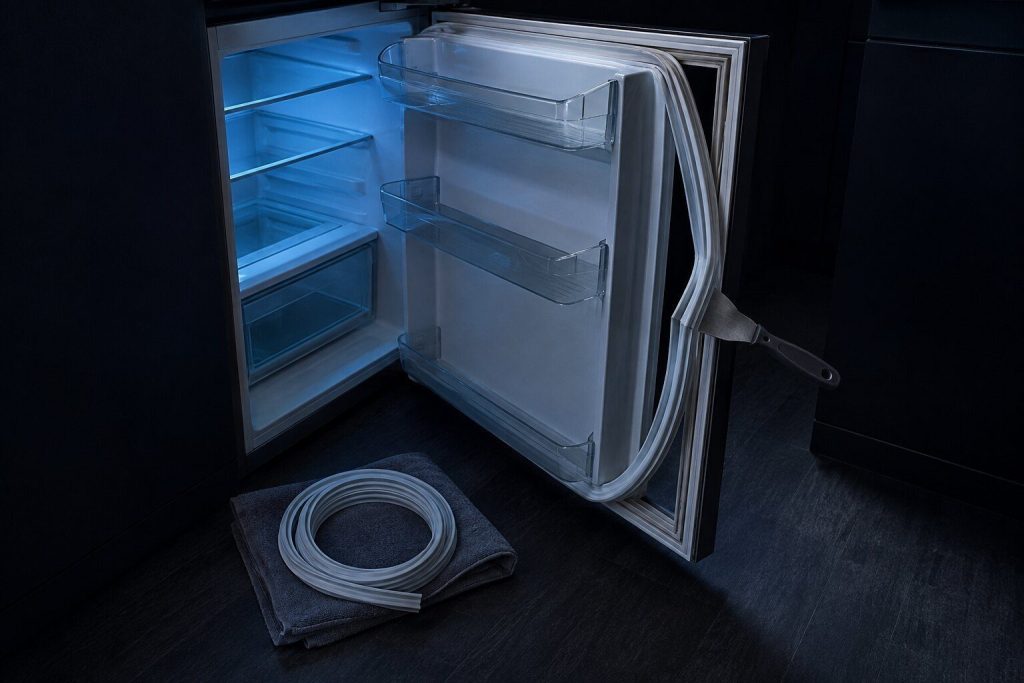
from $165 Door seal replacement
A gasket that no longer seals is a slow, expensive problem: the cabinet runs longer, the compartment nearest the leak drifts, and condensation appears where nobody expects it. Panel-ready doors make it likelier than on ordinary refrigeration, because the door carries the weight of a cabinet front and its hardware, and a hinge that has settled under that weight pulls the seal away from the frame along one edge. Replacing the gasket without correcting the door is how the same problem comes back within a year, so we do both or neither.
- Panel weight settles hinges — the seal is often the symptom, not the cause
- A dollar-bill test along all four edges, not a look at the worst corner
- Door alignment corrected at the same visit or the problem returns
-
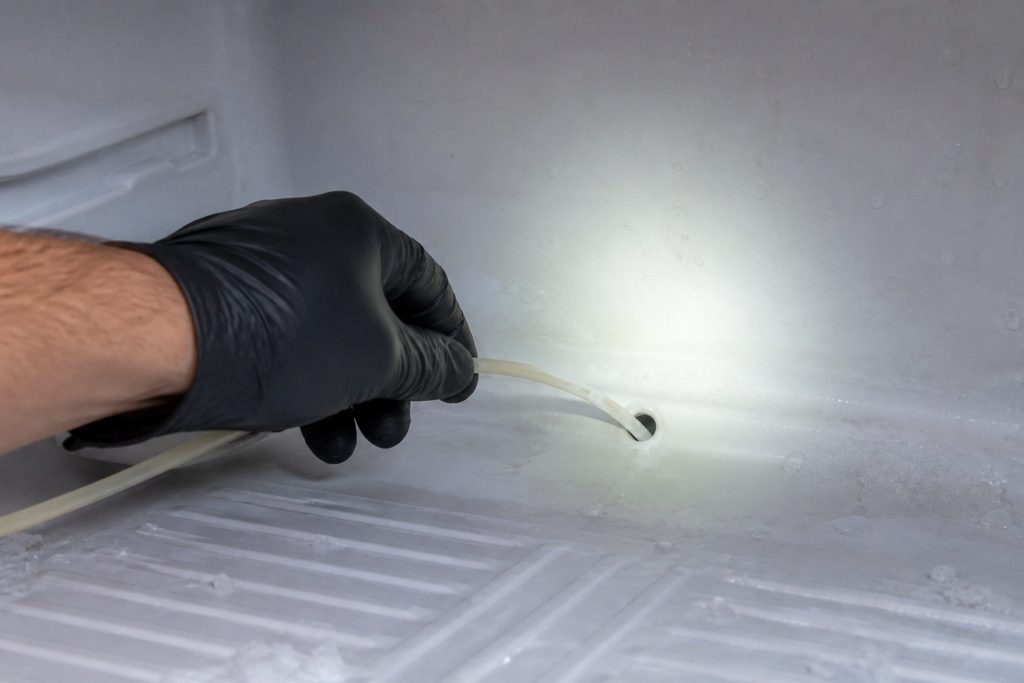
from $155 Refrigerator leak repair
Water in the base of a built-in cabinet is worse than water under a freestanding one, because it has somewhere to go: the floor under the joinery, the base of the cabinet beside it, and in a condominium sometimes the ceiling below. There are only a few sources — a blocked defrost drain, a split or loose water line, the ice module's fill path, a door that no longer seals in a humid kitchen — and finding which one it is takes less time than the damage takes to happen. If there is water on the floor in front of a column, turn the supply off at the valve and call.
- Under built-in cabinetry a leak reaches the floor and the neighbors, not a drip tray
- Four likely sources, and they are told apart by where the water is
- Supply off at the valve first — the diagnosis can wait, the joinery cannot
-
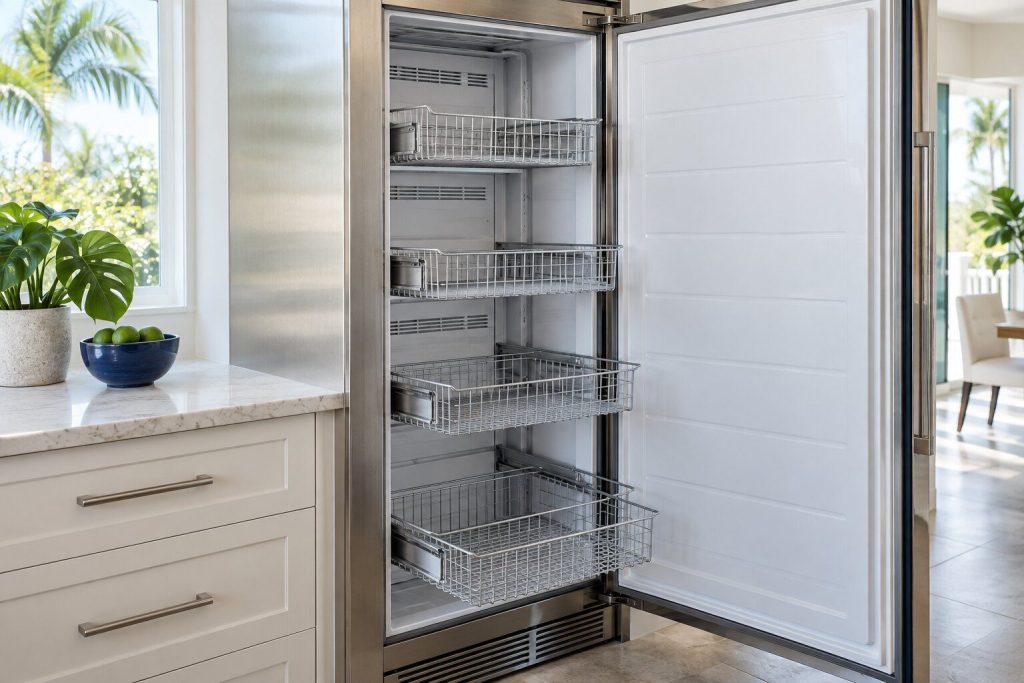
from $185 Freezer column repair
Every freezer this make builds is a column, which changes both the problems and the stakes. There is no second compartment to carry the load while a part is ordered, so a failure here empties a cabinet that often holds a great deal. The narrow column packs two ice makers, two drawers and its own sealed system into eighteen inches, and that density is why so many calls about it are really calls about airflow: drawers overloaded past the vents, or a base grille covered after a floor was laid. We check that before anything is opened.
- No second compartment — a problem here empties the cabinet
- Two ice makers and two drawers inside eighteen inches on the narrow column
- Overloaded drawers and covered grilles imitate a failing system
-
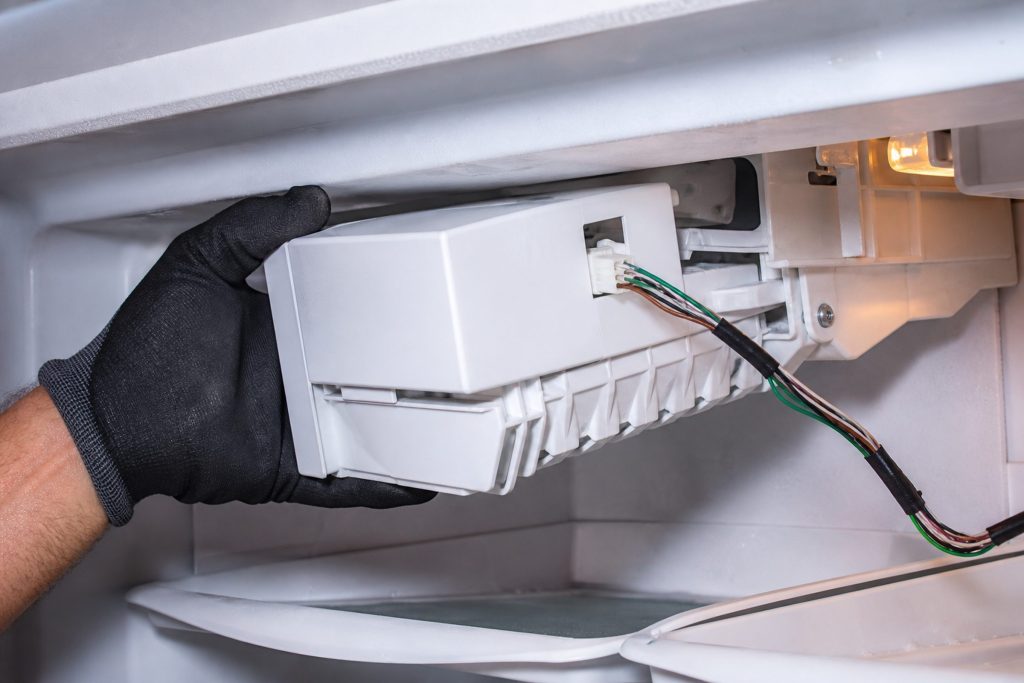
from $165 Ice maker repair
The ice maker is a module inside a cabinet rather than an appliance of its own on this badge — there is no standalone ice machine in the line. On the freezer columns there are two of them, which is genuinely useful for diagnosis: both stopped points upstream at the water supply, the inlet valve or the fill tube, while one stopped and one working points squarely at the module itself. Hollow or slow ice is a third case and usually a fill or a temperature problem rather than a mechanism that has failed.
- Two modules on the freezer columns — which one stopped is half the diagnosis
- Both stopped is a water problem; one stopped is a module problem
- Hollow or slow cubes are usually fill volume, not a broken mechanism
-
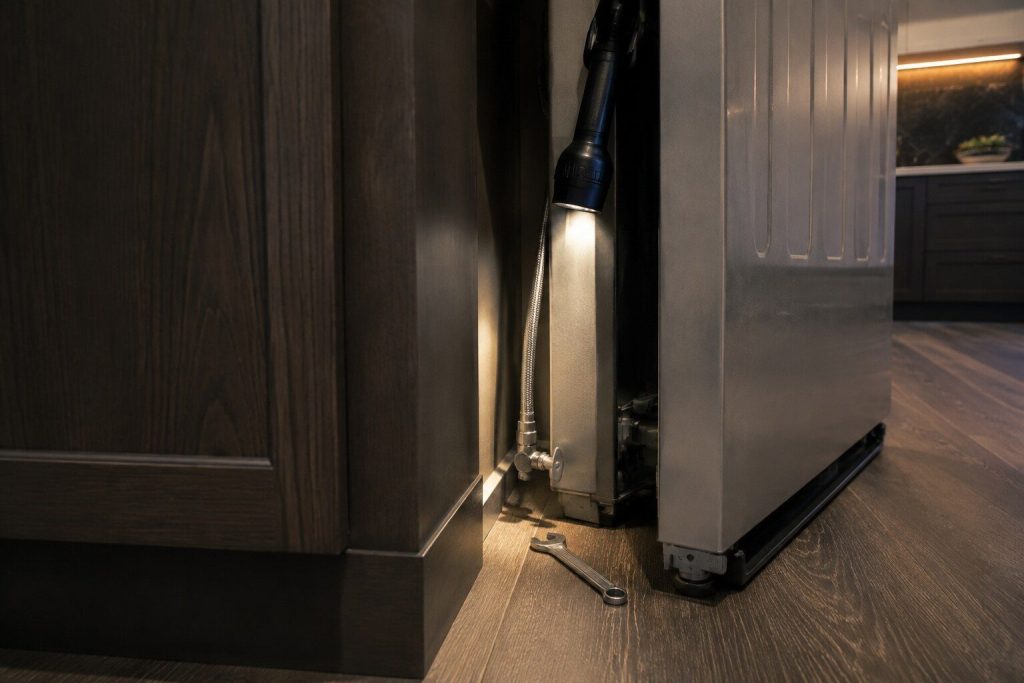
from $139 Water line and fill valve service
Everything upstream of the ice module, which is where most ice complaints actually live. The supply line runs behind cabinetry, the valve sits at the back of the machine, and the fill tube can partially freeze without ever stopping completely. In South Florida the additional factor is scale: a valve that has been fed hard water for years closes slowly and passes a trickle, which produces small hollow cubes on both modules at once — a symptom people reasonably read as two failed ice makers.
- Most ice problems are upstream of the module, not in it
- Scale makes a valve pass a trickle rather than fail outright
- Both modules affected at once is nearly always this
-
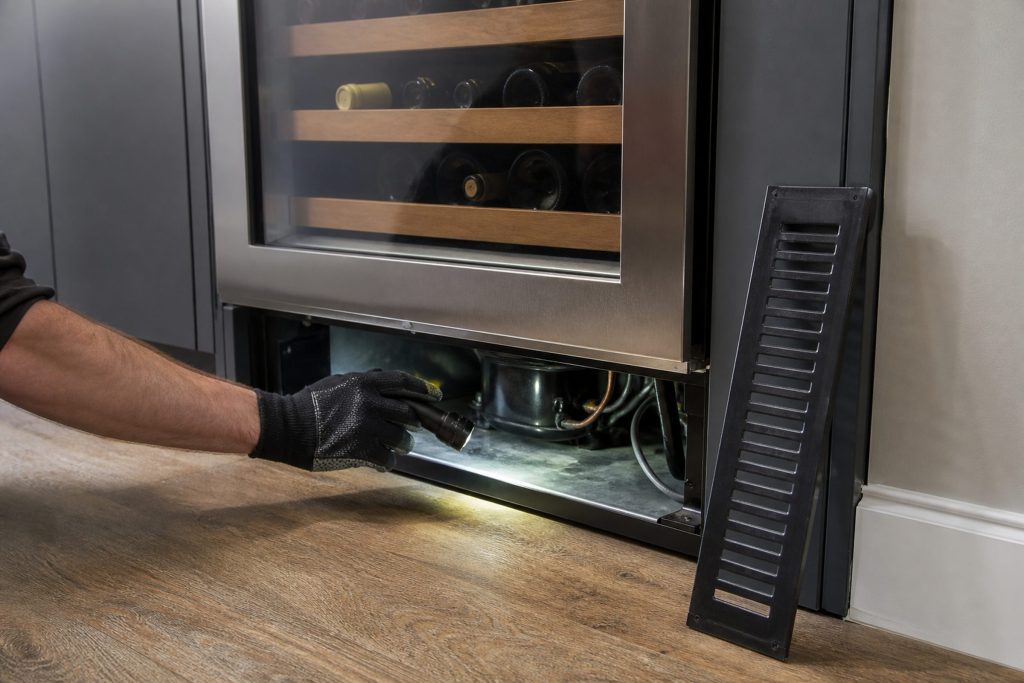
from $185 Wine column not cooling repair
A wine cabinet specified to hold within about a third of a degree is a machine where a two-degree drift counts as a failure, and the owner who calls about it is not being fussy. The useful question is how many zones are wrong. One zone adrift while the others hold is a division-of-airflow problem — that zone's sensor or damper — and stays a small repair. All three drifting together moves the diagnosis to the system feeding them, and that is where the cabinet's age and its condenser start to matter.
- One zone wrong is local; three zones wrong is the system
- Two degrees is a problem on a cabinet specified to a third of one
- A full cabinet holds temperature far better than an empty one during a visit
-
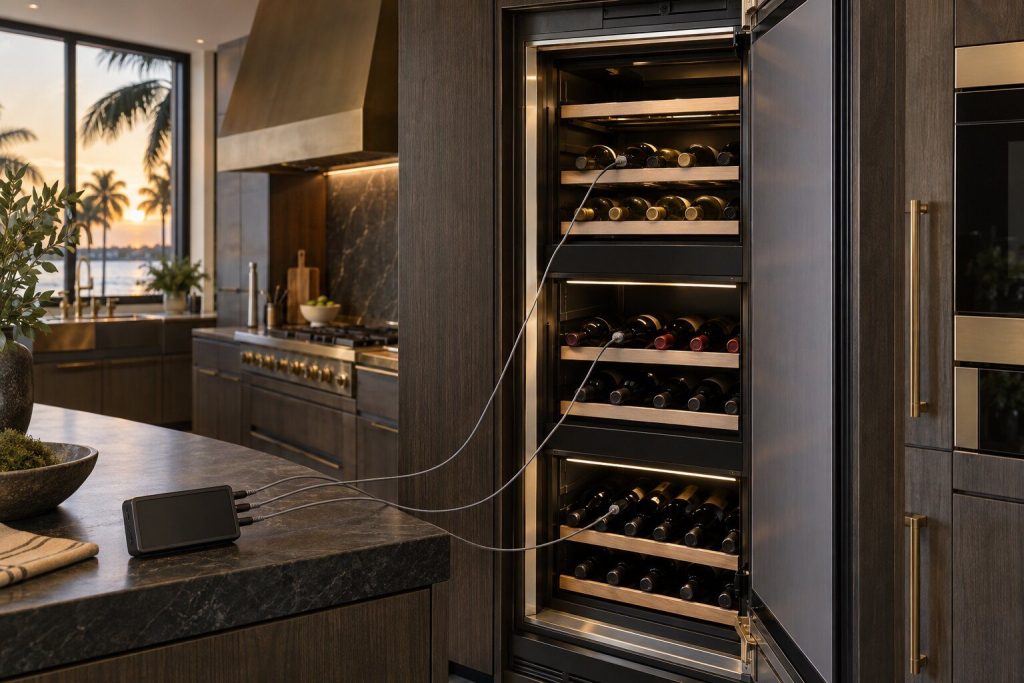
from $165 Wine zone calibration
Measuring what the cabinet is actually doing, zone by zone, against what its display claims. On a three-zone column with a tight specification the two can separate slowly — a sensor that reads a degree optimistic, a damper that no longer closes fully — and nothing about that is visible from the front. Calibration is instrument work rather than adjustment by feel: probes in each zone, logged over a period long enough to include a compressor cycle, then correction where the reading and the truth have parted company.
- Probes in each zone, logged across a full compressor cycle
- Corrects the drift between what the cabinet does and what it says
- Worth doing before a collection is moved in, not after
-
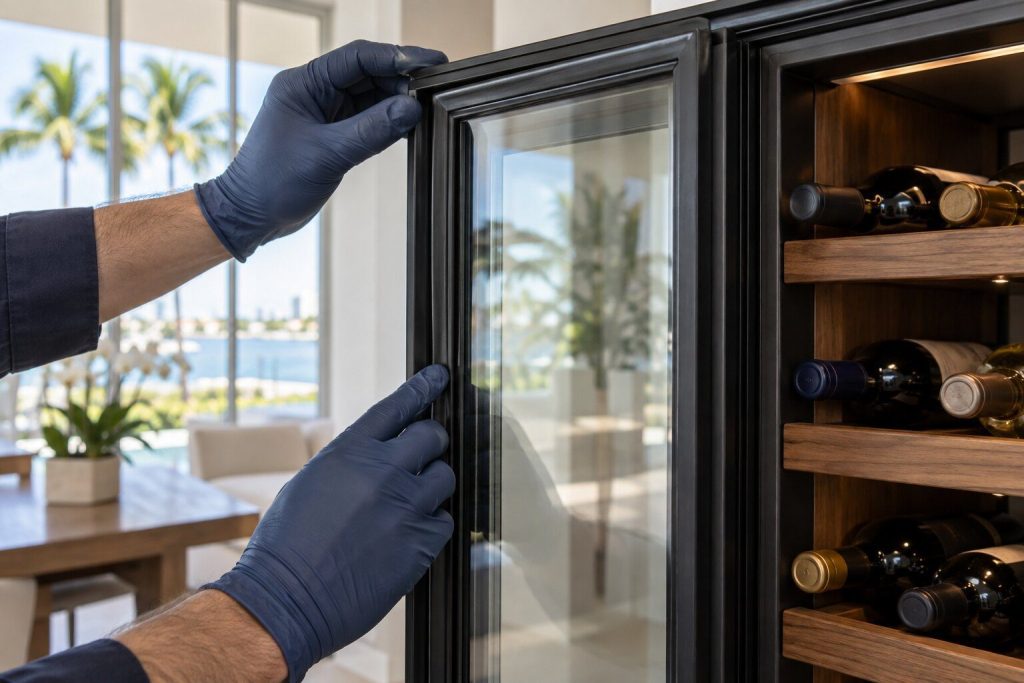
from $149 Wine door and seal service
The door of a wine column is a piece of equipment in itself: argon-filled triple glazing that keeps ultraviolet light and heat out of the cabinet, a gasket that has to seal against a room at eighty per cent humidity, and a push-to-open mechanism that people use several times a day. Condensation on the outside of the glass, or glass that is cold to the touch, means the cavity or the gasket is letting the cabinet fight the kitchen — and in this climate the cabinet loses that fight slowly, expensively, and out of sight.
- Cold outer glass or condensation on it is a real problem, not humidity
- The gasket seals against a Miami kitchen — it works harder here than anywhere
- Push-to-open is a mechanism and wears like one
-
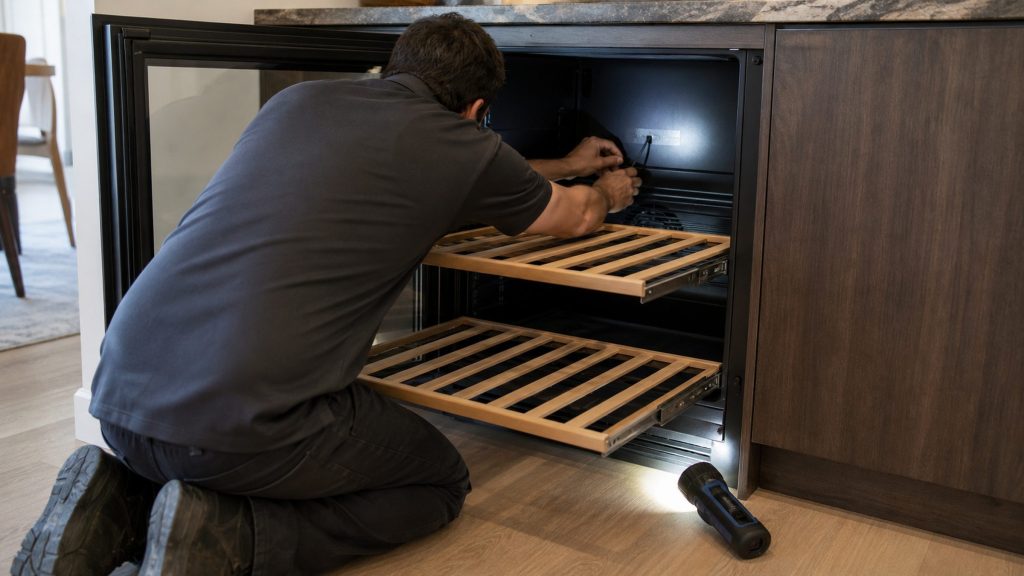
from $119 Glideracks and runner service
The oak racks in these columns glide out on runners so that bottles come forward in a tray rather than being reached for one at a time, and that mechanism is used more than any other part of the cabinet. Runners bind, a rack sits proud and stops the door sealing, a rail comes loose and a hundred bottles' worth of weight goes somewhere it should not. It is the smallest visit on this list and one of the more satisfying, because the result is immediate and visible the moment you pull a shelf.
- Used more than any other part of the cabinet, and wears accordingly
- A rack sitting proud is a door-seal problem waiting to be misdiagnosed
- Small visit, immediate result
-
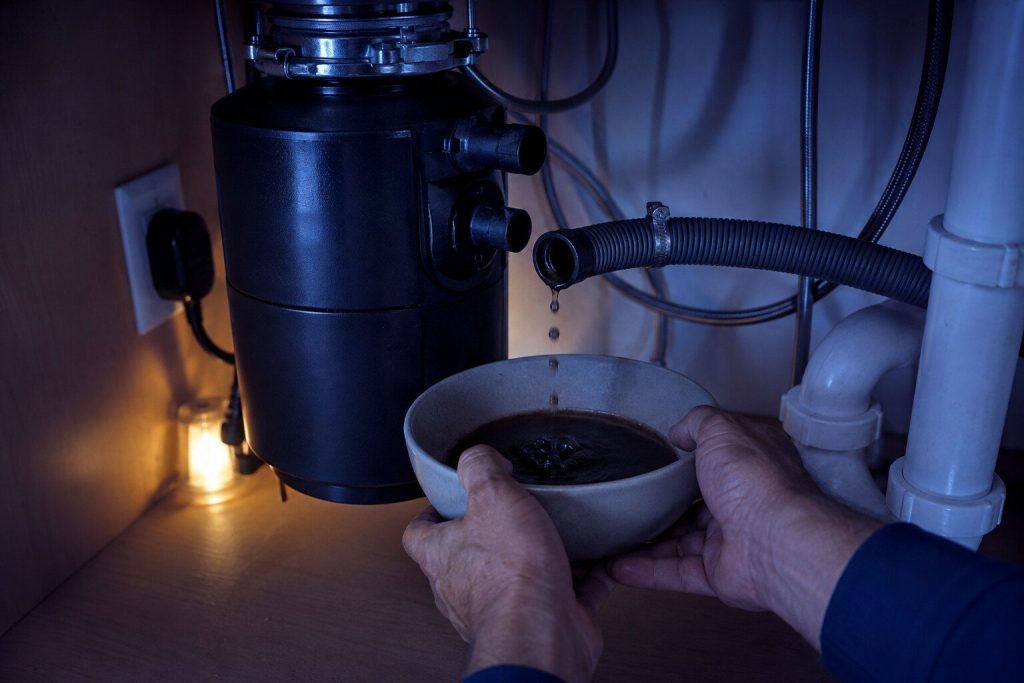
from $165 Dishwasher drain and pump repair
Water standing in the base at the end of a cycle is the commonest dishwasher call and rarely the pump itself. The path runs filter, sump, pump, hose and then whatever the kitchen fitter connected it to — usually a disposal or a standpipe, and usually the actual cause. On the current machines a drain problem reports as a letter code ending in C; on the older EDW and IDW dishwashers it reports as an F-number that shares nothing with it. Reading us the display exactly as written saves the first ten minutes of the visit.
- Filter, sump, pump, hose, and the connection somebody else made
- Current machines say a #C code; legacy EDW and IDW say F-1 to F-9
- Standing water is usually downstream of the appliance
-
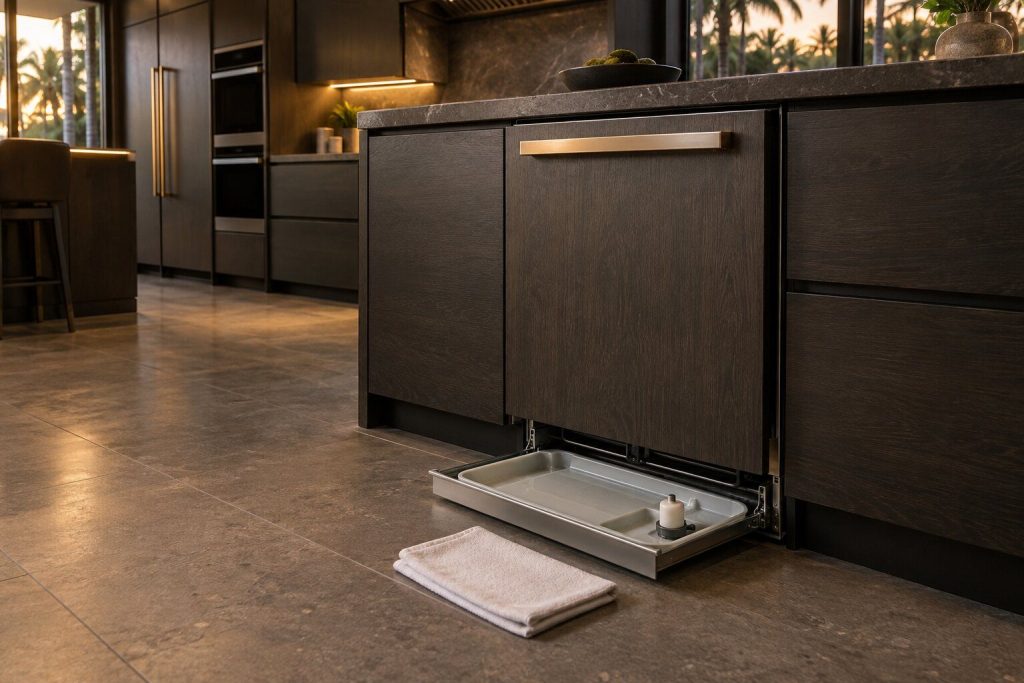
from $159 Dishwasher leak repair
A panel-ready dishwasher leaks into cabinetry rather than onto a floor, which is why a small problem here is worth treating quickly. The sources are few — the door gasket, the detergent dispenser, a hose fitting, the sump seal, or a machine that is overfilling — and they are told apart by where the water appears and when in the cycle. Machines with a leak-detection system will often stop themselves and report it, and that is the appliance protecting the kitchen rather than a failure to be reset away.
- Behind a cabinet panel the water goes into joinery, not onto the floor
- Where and when in the cycle tells us which of five sources it is
- A machine that stops itself and reports a leak is working correctly
-
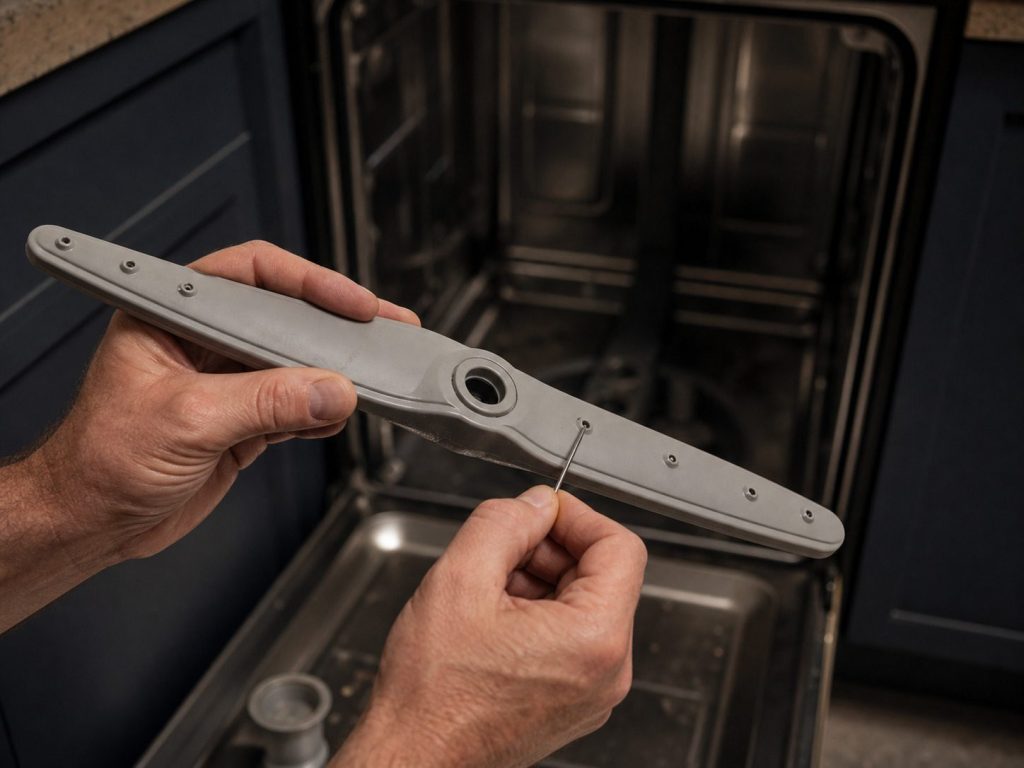
from $139 Wash performance service
Dishes coming out gritty, cloudy or wet is usually not one problem but three small ones together: spray arms partly blocked, a filter left too long, and water that is harder than the machine was set up for. This badge is unusual in having a softener built into the appliance, which means there is something to service that most dishwashers do not have — and a machine that washed perfectly for years and then declined is very often that softener rather than anything mechanical.
- Gritty, cloudy and wet are three different problems with three different answers
- The built-in softener has a service interval — this is where a slow decline starts
- Spray arms and the third rack's feed are checked under pressure, not by eye
-
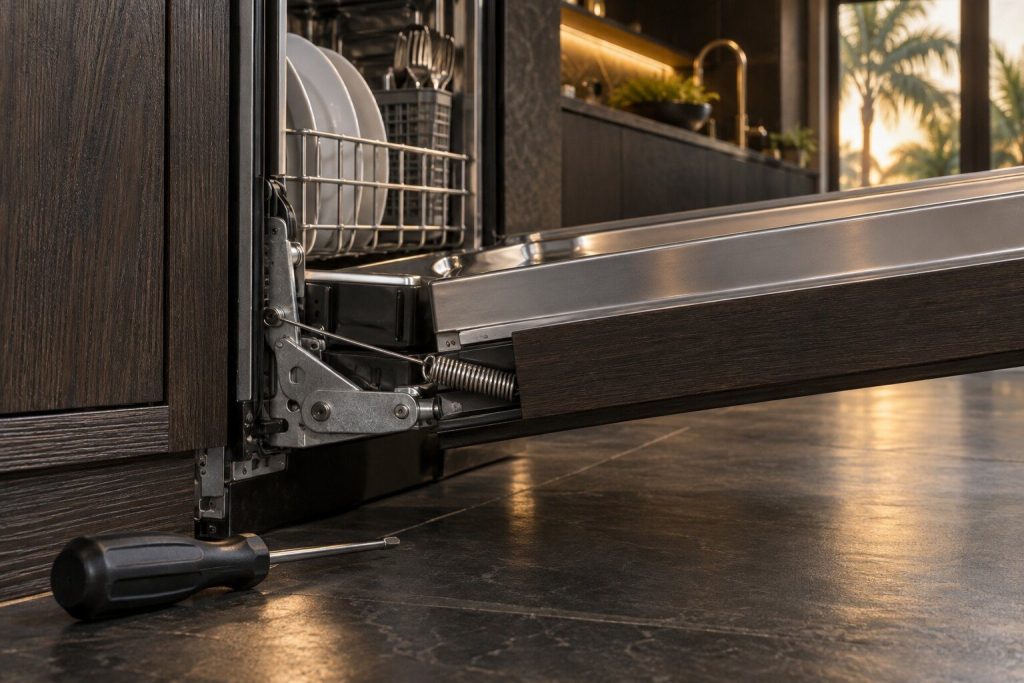
from $135 Door, latch and AutoRelease repair
The door of a panel-ready dishwasher carries a cabinet front, and the springs and hinges are tensioned for that weight. When a panel is changed, or a hinge cable frays, the door drops, the latch stops meeting the strike, and the machine refuses to start — which reads as an electrical problem and is entirely mechanical. On the current machines the door is also part of the drying system: it releases itself a few inches at the end of a cycle, and a door that never releases or releases mid-cycle is a genuine problem rather than a habit.
- A dropped door is mechanical, even though it presents as 'will not start'
- Hinge springs and cables are tensioned for the weight of the cabinet panel
- AutoRelease opening at the end of a cycle is correct behavior
-
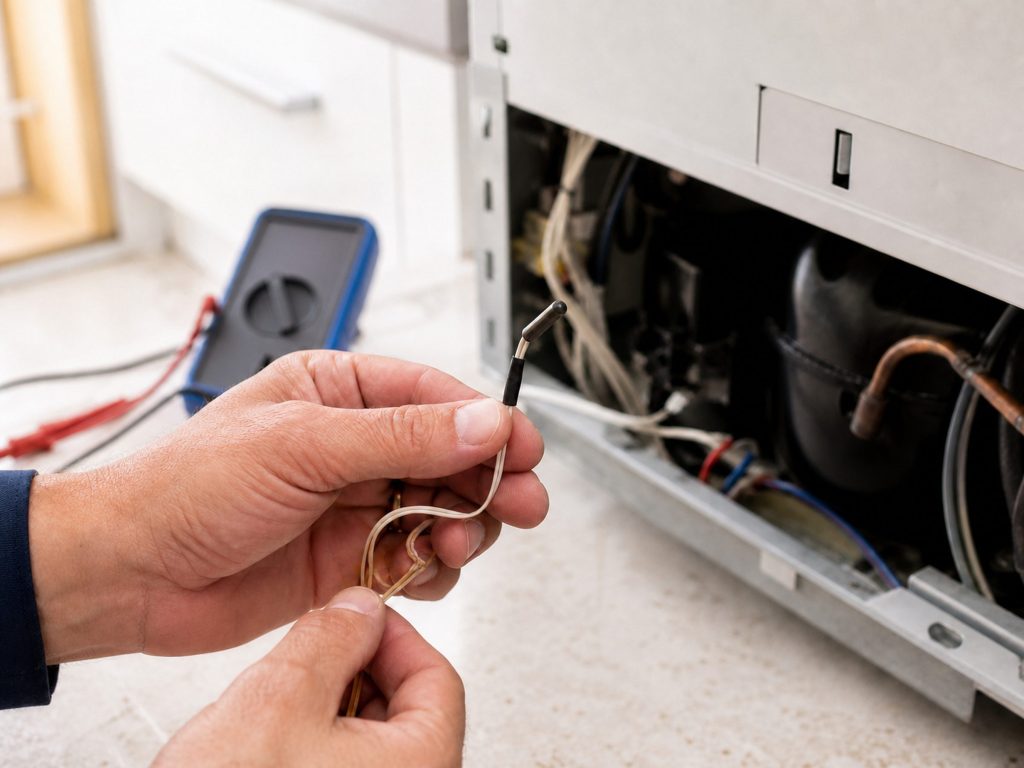
from $155 Drying and heat repair
Poor drying on a modern dishwasher is usually a misunderstanding before it is a problem, and we would rather explain that than sell a visit. These machines dry without a hot element roasting the load: they use residual heat and an opening door, which leaves plastics damp and glass dry, and that is the design. What is a problem is water still standing on upturned crockery, glass coming out cloudy and warm, or a machine that no longer heats the wash at all — and those three point at the heater, its thermistor or the control that runs them.
- Damp plastics with dry glass is the design, not a defect
- Cloudy warm glass and pooled water are the symptoms that matter
- Heater, thermistor and control tested as a set
-
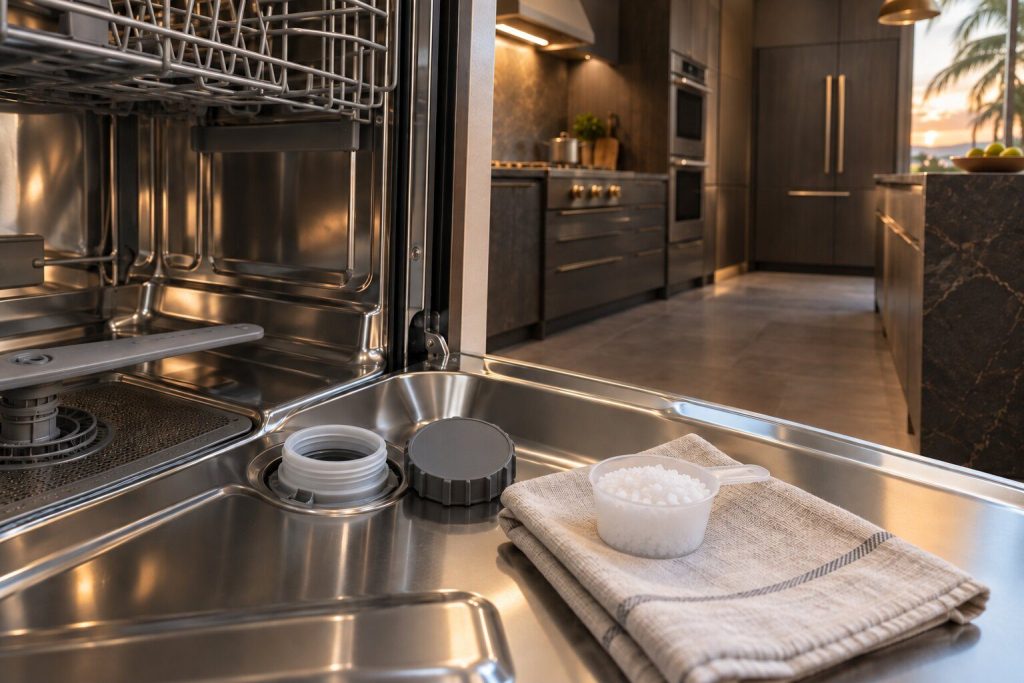
from $129 Built-in water softener service
A dishwasher with its own softener is unusual, and in South Florida it is the reason glassware in these kitchens stays clear for years longer than it otherwise would. It is also a maintenance item that nobody is told about: the chamber needs salt of the right kind, the setting has to match the water actually arriving, and the resin does not last forever. The clearest sign it needs attention is a machine whose performance has declined slowly and evenly — everything slightly worse, nothing actually broken.
- The reason glass stays clear in a hard-water city
- Needs the right salt, the right setting, and eventually new resin
- The symptom is a slow, even decline rather than a failure
-
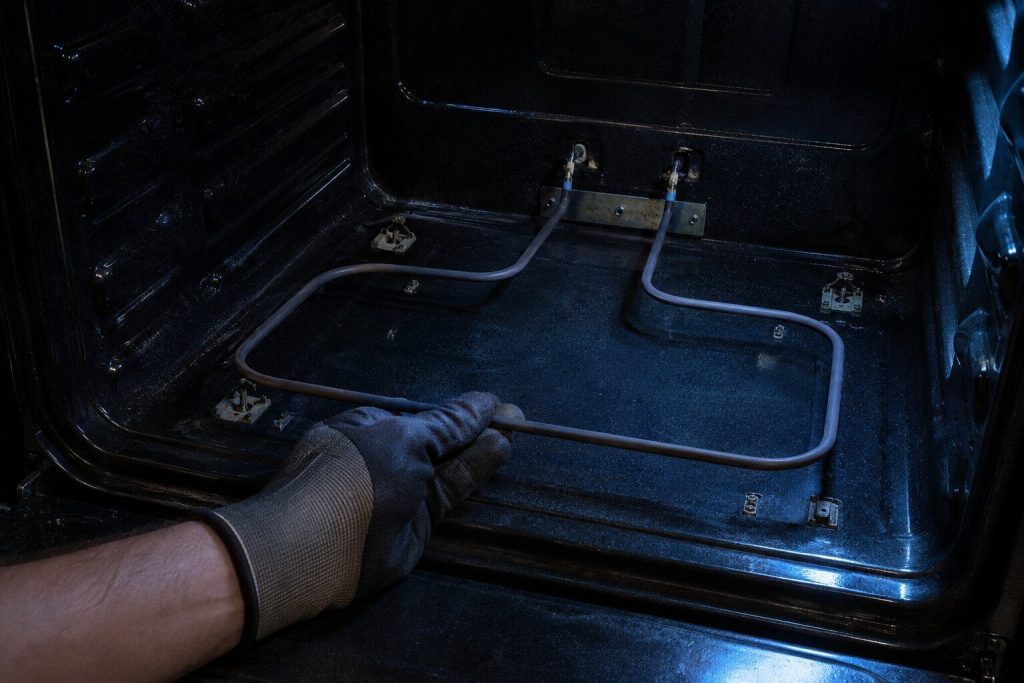
from $175 Oven not heating
An oven that will not reach temperature, or reaches it and cannot hold it, comes down to a short list: an element, a sensor reading wrong, a relay that no longer closes, or a control that has stopped asking. Which one it is takes measurement rather than opinion. On this badge the extra question is the era: a Classic ERC oven and a current one report entirely different codes for related problems, and F1, F2 and F3 in particular mean different things depending on whether the appliance is an older oven or an older range.
- Element, sensor, relay, control — decided by measurement, not by symptom
- F1, F2 and F3 mean different things on an old oven and an old range
- A double oven with one dead cavity keeps the repair on one side
-
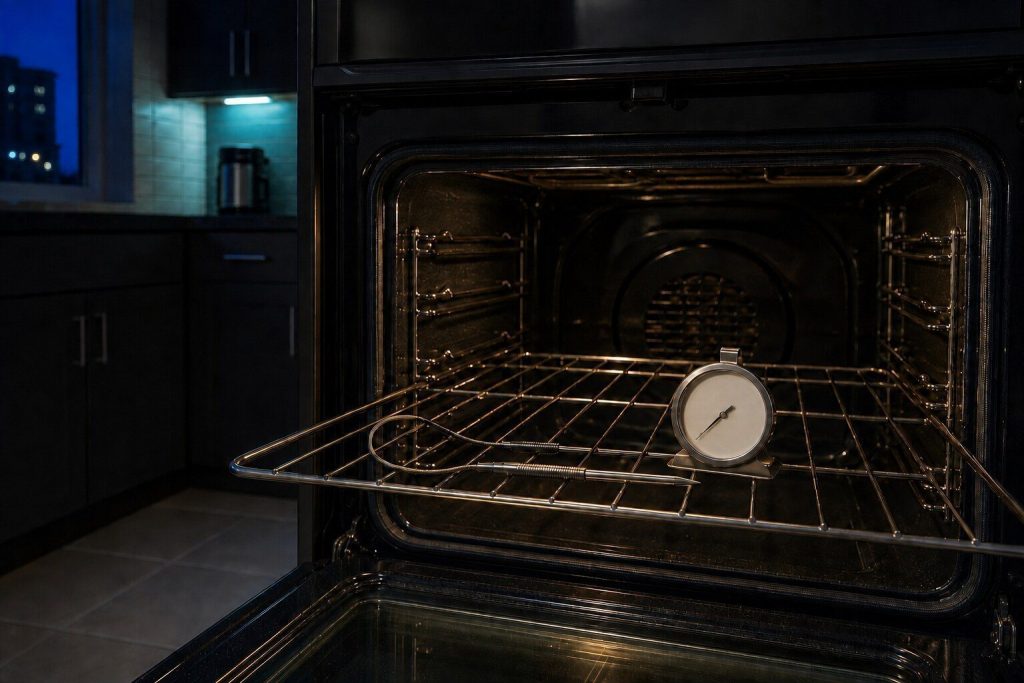
from $149 Temperature sensor and calibration
An oven that bakes badly while appearing to work is usually reading itself wrong. Sensors drift with age, and a cavity that is thirty degrees out sails through every self-test the appliance can perform because it believes its own reading. It is diagnosed with an independent probe and a logged preheat rather than by taste, and it is corrected either by calibration or by the sensor itself. On the steam models the same question is worth asking of the steam cycle separately, because it has its own sensing.
- An oven that is thirty degrees out passes its own self-test
- Independent probe and a logged preheat — not an oven thermometer left on a shelf
- Steam models sense the steam cycle separately and can drift separately
-
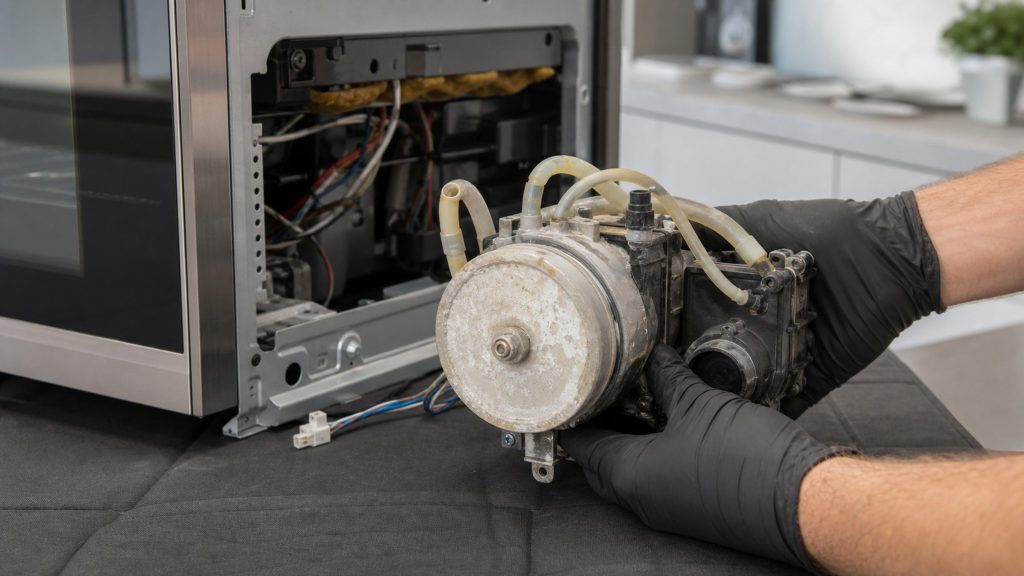
from $175 Steam oven water system
The steam models carry a water system the plain ovens do not have: a reservoir, a pump, a path into the cavity and a descaling interval that South Florida water makes non-negotiable. Most problems here are scale rather than mechanism — a pump straining, a steam cycle that takes far longer than it should, a reservoir that reports empty when it is full because its sensing is fouled. Descaled and serviced on schedule these systems last well; ignored, they take the pump with them, and that is a considerably larger repair.
- A reservoir, a pump and a descaling interval the non-steam ovens do not have
- Most problems are scale, and scale eventually takes the pump
- A reservoir reporting empty while full is fouled sensing, not a broken tank
-
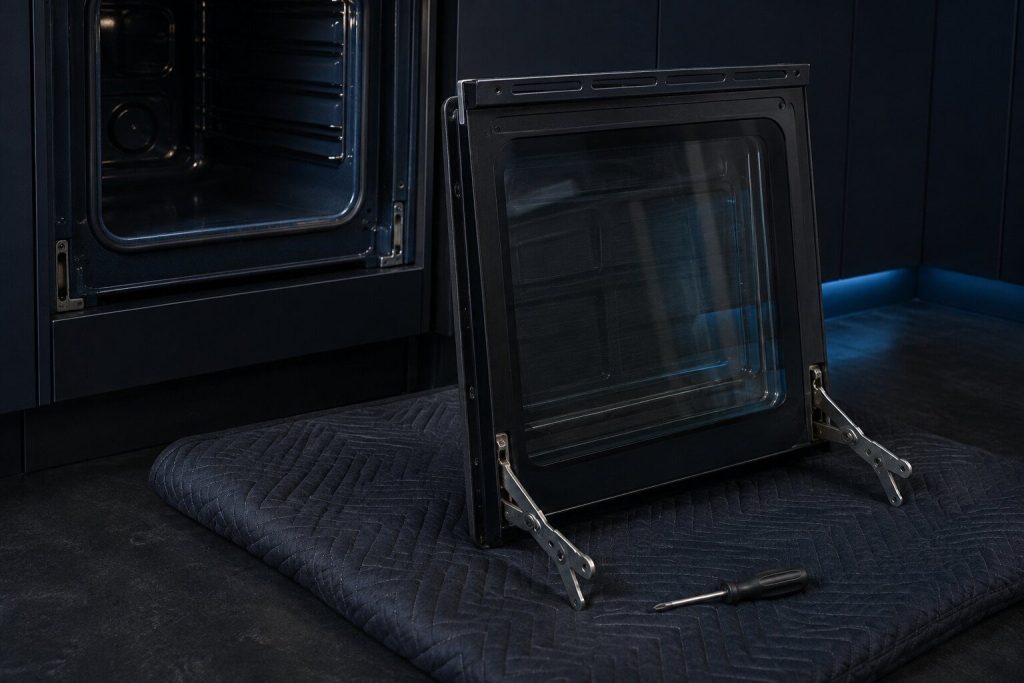
from $169 Oven door and hinge repair
A door that no longer sits square costs an oven its temperature and its efficiency, and on a wall oven set into a tall cabinet it is also the part most likely to be noticed by everybody in the kitchen. Hinges take the weight of a triple-glazed door many times a day; springs weaken, a hinge arm bends after a door is leaned on, and the seal along the top loses contact first. Glass that has fogged between panes is a separate matter and usually means the stack has been opened or the seal around it has failed.
- A door out of square is a heating problem before it is an appearance one
- The top edge of the seal loses contact first — that is where to look
- Fogging between panes is a sealed-stack problem, not condensation
-
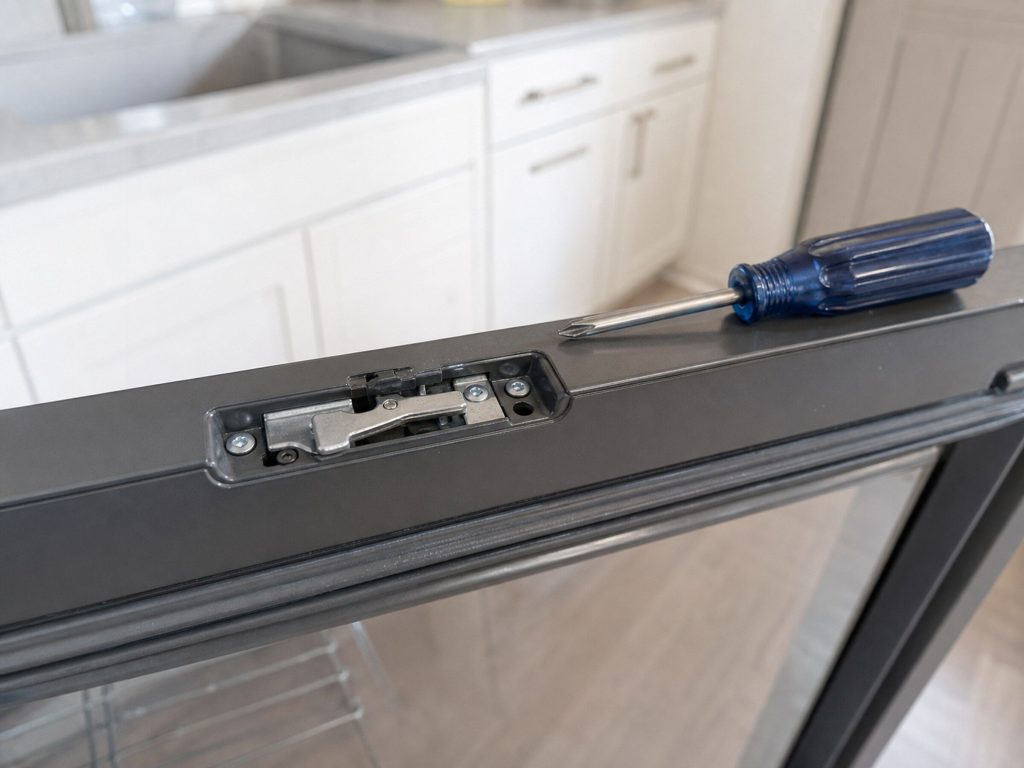
from $175 Self-clean and door lock repair
The self-clean cycle is the hardest thing an oven ever does to itself, and it is where marginal parts fail: the door lock motor, the thermal fuse, the sensor at full temperature, occasionally the control. A door locked shut after a cleaning cycle is the classic aftermath and it is a repair rather than a catastrophe. We are also honest about the cycle itself — on an appliance of this age and value, running a pyrolytic clean is a decision with a cost, and we will say when we think a manual clean is the wiser option.
- Self-clean is where marginal parts fail — that is why problems cluster after it
- A door locked shut afterwards is an ordinary repair
- We will tell you when not to run the cycle at all
-
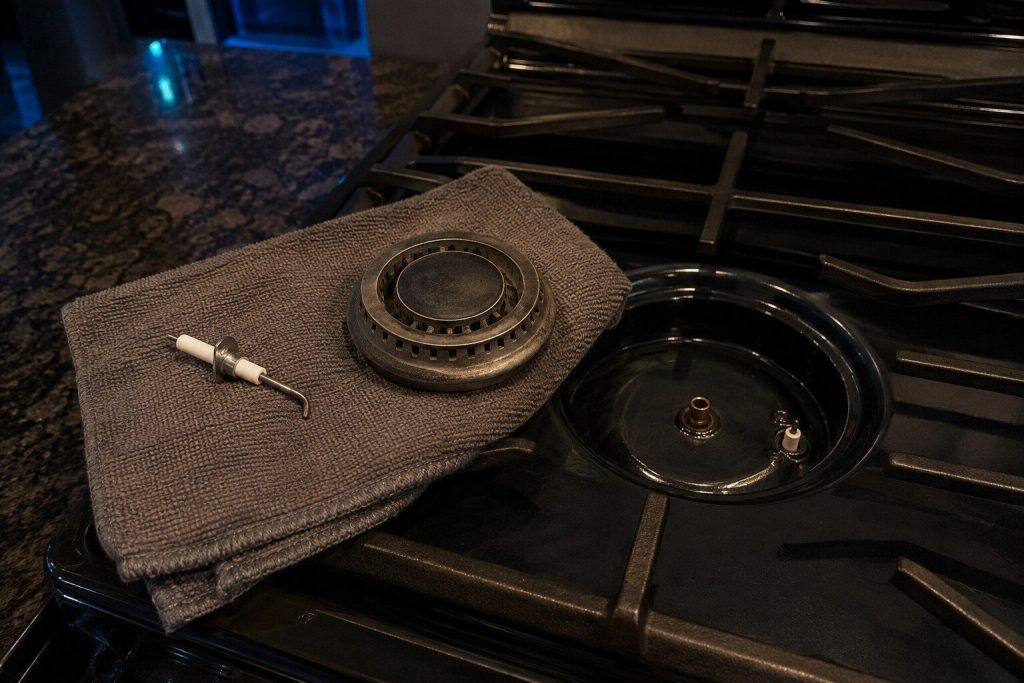
from $155 Gas burner and igniter repair
A burner that clicks without lighting, lights and goes out, or will not come down to a simmer. In Miami the usual culprits are salt air and humidity on the igniter, and a cap or head that went back slightly wrong after a clean — which is why so many of these calls date from the week the hob was scrubbed. The professional burners on the rangetops complicate it pleasantly: they are built to relight themselves after a draft or a boil-over, so a burner that keeps going out may be that system rather than the burner at all.
- Most of these problems begin the week the hob was deep-cleaned
- Salt air and humidity are what actually kill igniters here
- On the pro burners, repeated flame-outs may be the relight system
-
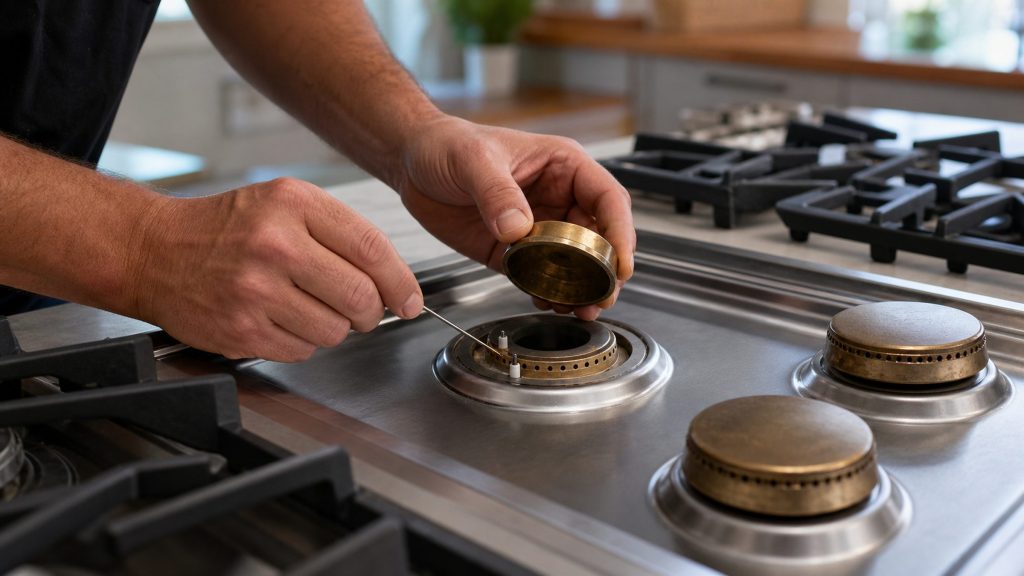
from $195 Rangetop service
The professional rangetops are 36 and 48 inches of sealed brass burners, illuminated knobs and a griddle or wok ring in place of grates, and they are worked harder than any other appliance in these kitchens. Service is mostly about restoring the range of the burners rather than fixing failures: simmer settings that have drifted, ports partially blocked by years of boil-over, knob illumination that has died on one burner, and the griddle plate's surface. It is a heavy appliance and a satisfying one to bring back.
- Six sealed brass burners built to sear and to genuinely simmer
- Illuminated knobs fail one at a time and are a separate small repair
- The griddle and wok ring are accessories that live where grates would
-
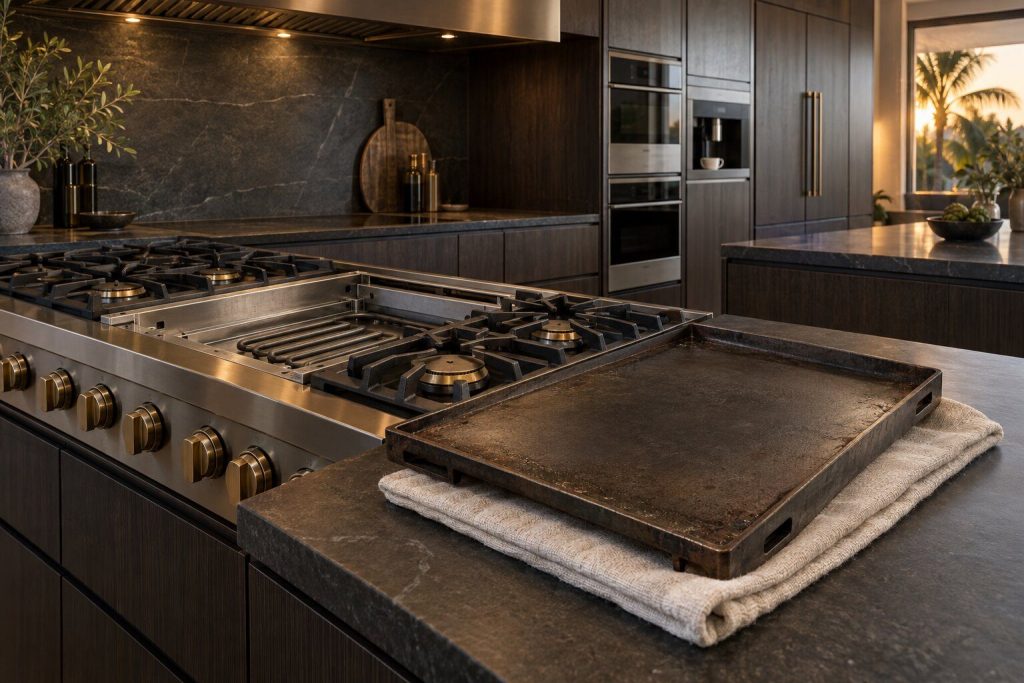
from $159 Integrated griddle service
The griddle built into the largest range is its own heated surface with its own control, which means it can be wrong while every burner beside it is right. The two failure patterns are quite different and worth telling apart before a visit: a griddle that never reaches temperature at all points at the element or its control, while one that gets there and then drifts away points at sensing or at a thermal cut-out doing its job. Surface condition matters too — a plate that has been cleaned with the wrong thing cooks unevenly and reads as a problem.
- Its own element and control — it fails independently of the burners
- Never heats and drifts after heating are two different repairs
- A mistreated plate surface cooks unevenly and imitates a problem
-
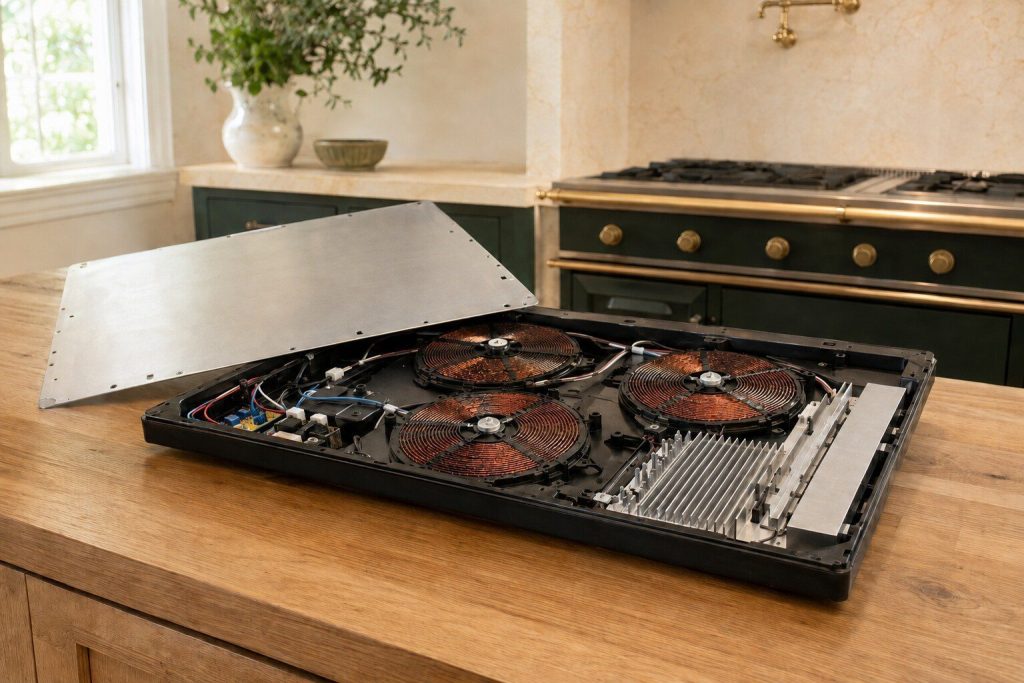
from $205 Induction cooktop repair
An induction surface is an electronics repair under glass, and the good news is that each zone has its own coil and drive, so one dead zone rarely means the whole cooktop. What matters most is telling failure apart from protection: a zone that runs for a few minutes at high power and then stops is very often defending itself against heat it cannot shed, and the cause is a blocked vent or a cabinet packed tight underneath rather than a problem in the appliance. That distinction is worth making before anybody quotes for parts.
- Per-zone coils and drives — one dead zone is usually local
- Cutting out after minutes at high power is usually protection, not failure
- Pan compatibility is a magnet test, and no repair changes it
-
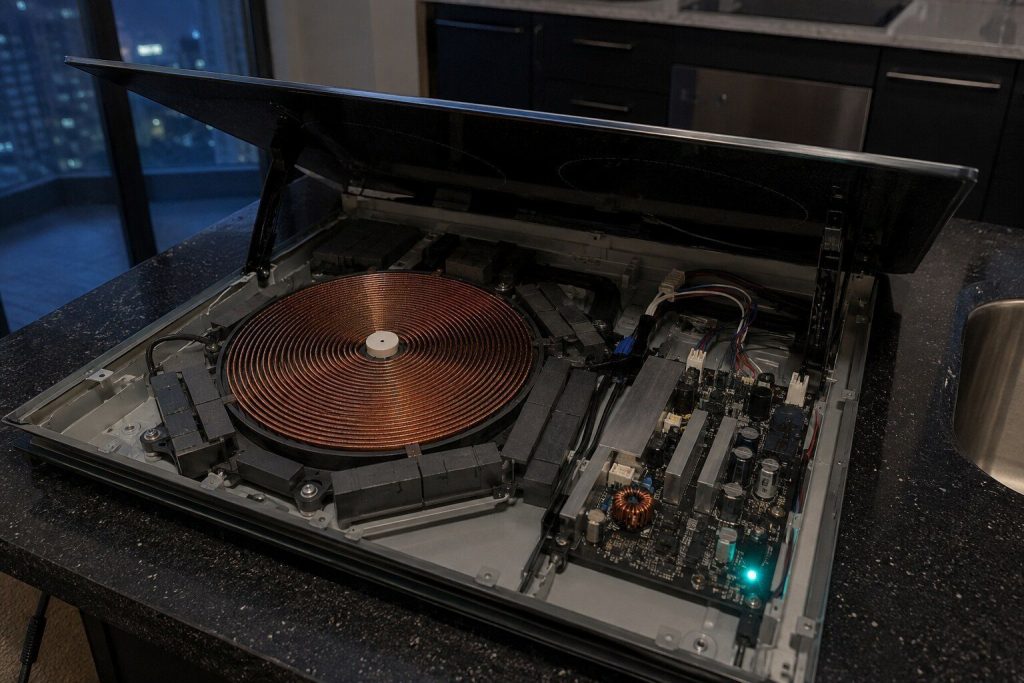
from $275 Cooktop glass replacement
Cracked or chipped glass on an induction surface is not cosmetic: the glass is part of the appliance's insulation and its seal against everything spilled on it, and a crack lets liquid reach the electronics beneath. On a frameless surface bonded into a stone worktop the replacement is careful work — the old panel comes out without damaging the stone, and the new one is bonded and sealed so the edge is as clean as it was. It is mostly a parts cost rather than a labor one, and we say so plainly when the number surprises people.
- A crack lets liquid into the electronics — it is not cosmetic
- Frameless glass in a stone worktop is careful work at both ends
- Mostly the cost of the panel, and we say so
-
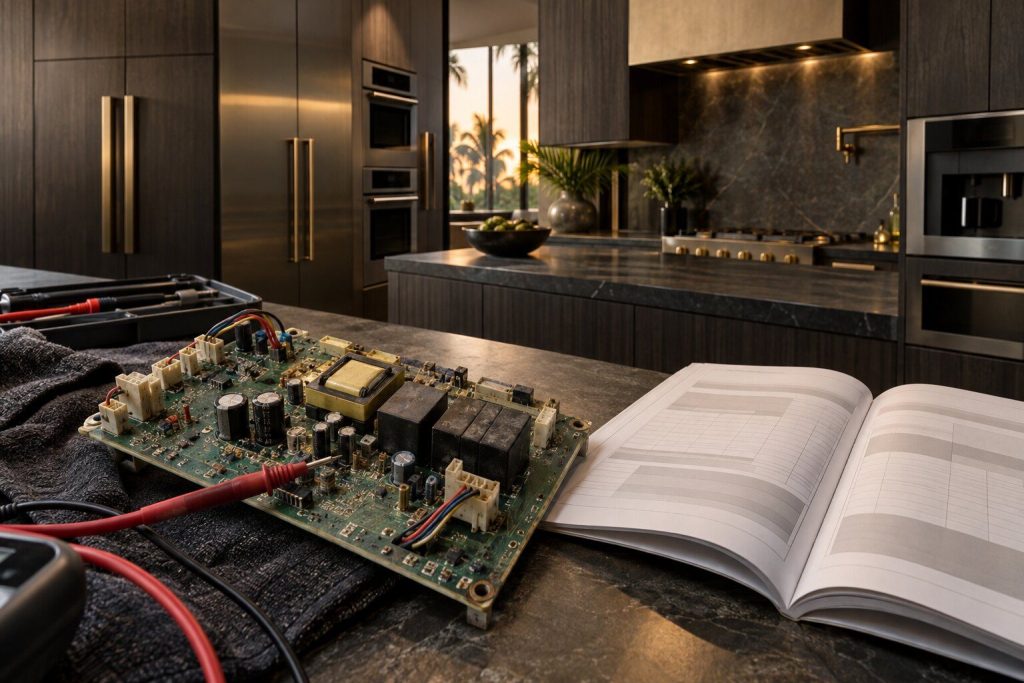
from $125 Legacy control diagnosis
The service that exists because this badge changed hands in 2016. Appliances made before that run Dacor's own boards and report F-codes — F0 to F8 on a Classic ERC oven, F1 to F95 on an ER-series range, F-1 to F-9 on an EDW or IDW dishwasher — and none of those strings exist on the current platform. A technician who only knows the current machines will read them wrongly or not at all, which is why owners of these appliances are so often told their machine is unfixable. It usually is not. What it needs is the right table and an honest answer about parts.
- Pre-2016 codes share nothing with the current platform
- F1, F2 and F3 mean different things on a Classic ERC oven and an ER range
- The honest part of this service is the parts answer, given before the visit
-
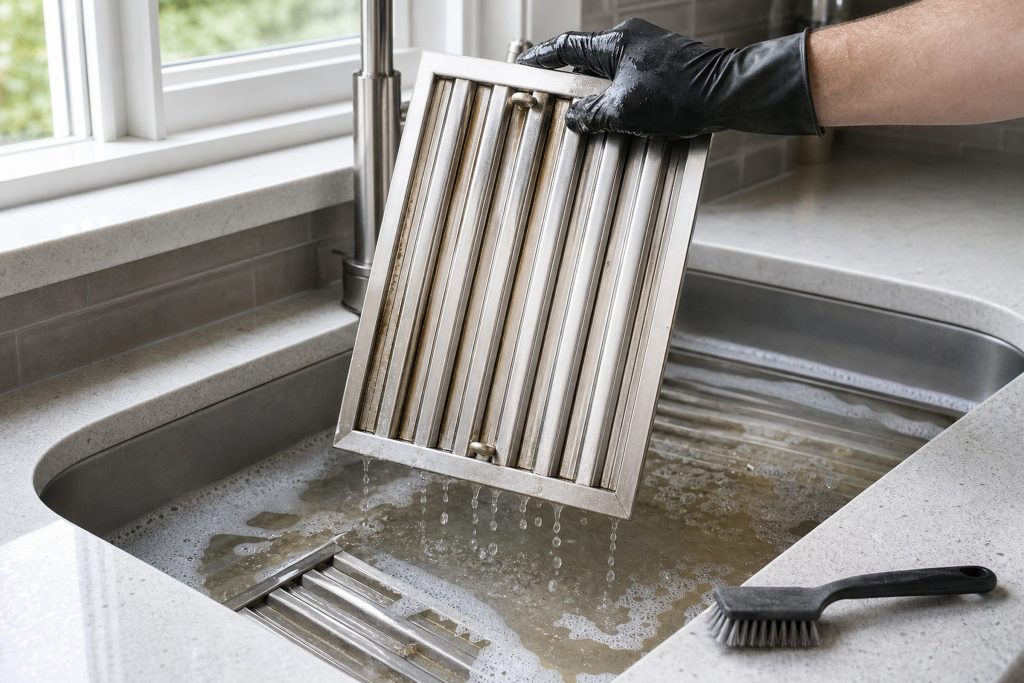
from $165 Hood motor and blower service
Noise and weak extraction are the two hood complaints, and both are usually grease before they are parts. A blower wheel collects it unevenly, goes out of balance and hums or rattles at particular speeds; filters block gradually enough that nobody notices the day the kitchen stopped clearing. What is not grease is a bearing, a mount that has loosened, or a duct that has come apart above the ceiling — and in South Florida buildings, with long shared runs, the duct is a more common answer than people expect.
- Gradual noise is grease and balance; sudden noise is a bearing or a mount
- Weak extraction starts at the filters and often ends at the duct
- Long shared duct runs are ordinary here and are part of the diagnosis
-
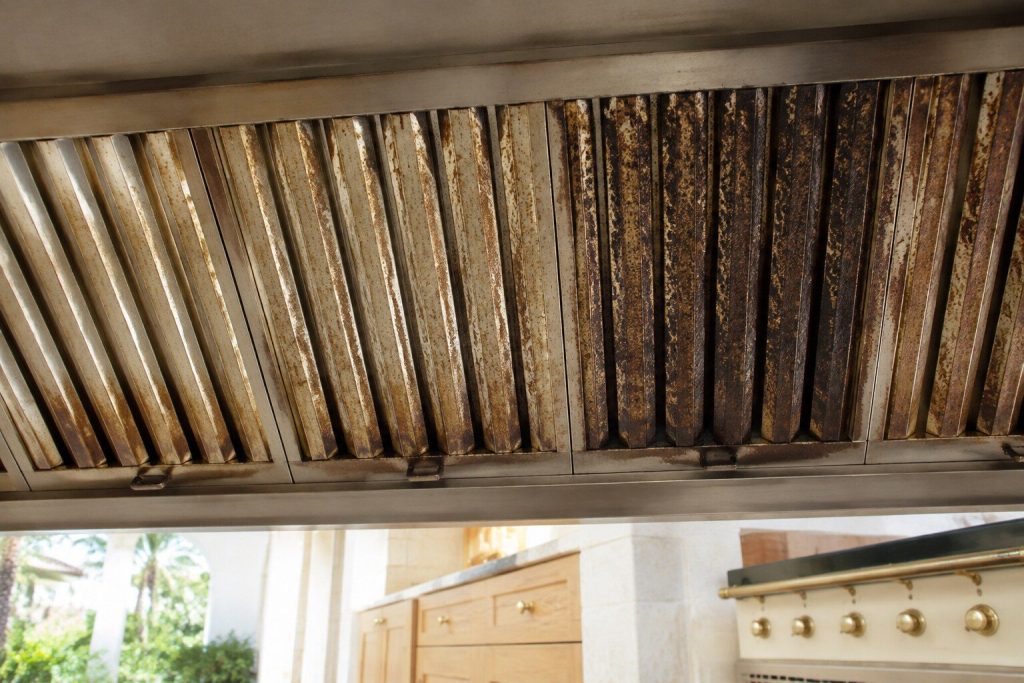
from $175 Hood liner service
The liner inserts are about five and a half inches tall and live inside a hood built by a joiner, which is why owners put off calling: they assume the carpentry has to come apart. In nearly every case it does not. These units are designed to be serviced from below — filters down, blower and lamps reachable through the opening — and a kitchen that has been venting badly for a year can usually be put right in a single visit without a mark on the millwork.
- Designed to be serviced from below — the joinery stays where it is
- About five and a half inches of appliance inside somebody else's hood
- The postponed repair is usually the easy one
-
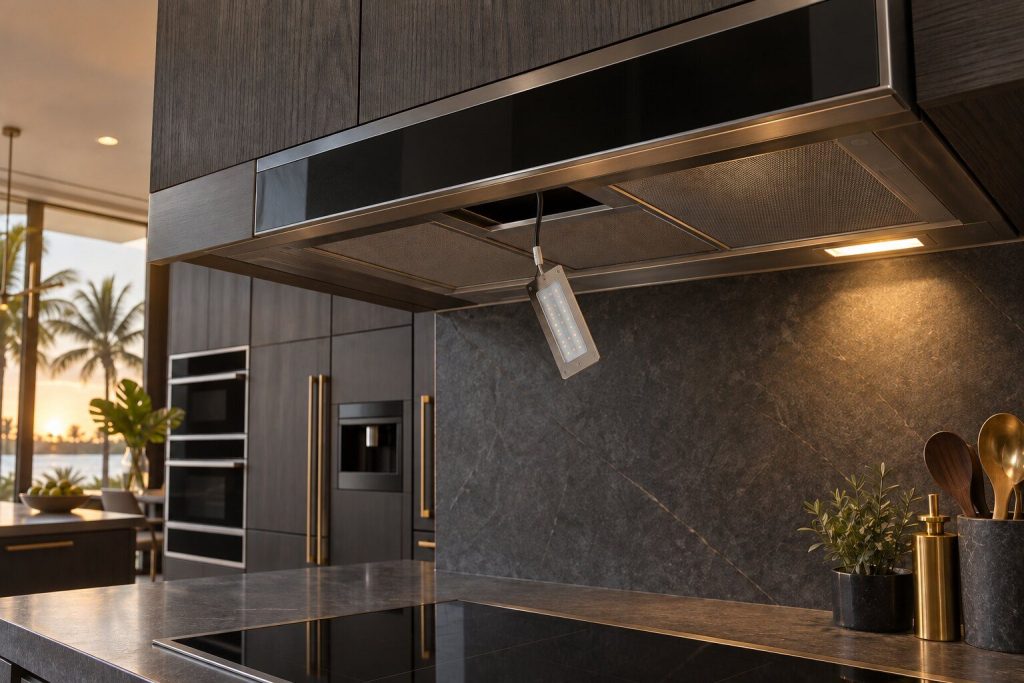
from $119 Hood light and control service
Lamps and controls are the small end of hood work and the most common call. LED modules fail one at a time, so a single dark lamp is a module or its driver rather than a hood at the end of its life; a whole strip dark points at the driver or the supply. The glass touch controls on the canopy hoods have their own failure — a panel that responds to some presses and not others, usually the panel itself rather than the board behind it. Both are short visits, and a photograph from below tells us most of what to bring.
- One dark lamp is a module; all dark is the driver or the supply
- Touch panels that half respond are usually the panel, not the board
- A photo from below decides what goes on the van
-
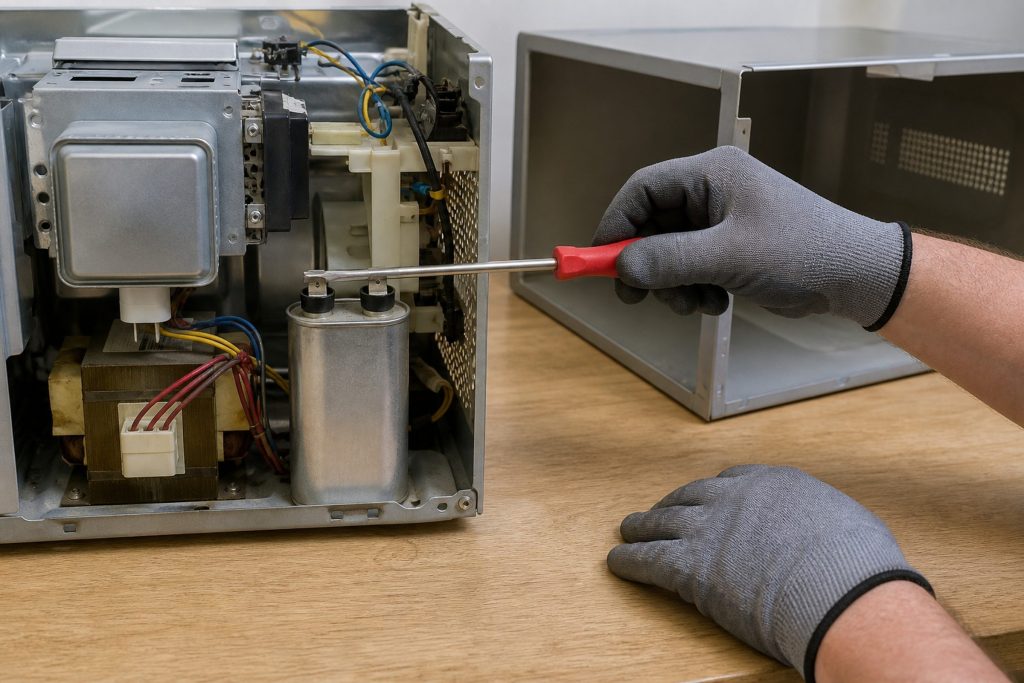
from $195 Built-in microwave repair
A built-in microwave is worth repairing where a countertop one is not: it is fitted, matched to the kitchen and expensive to replace, and the usual problems are ordinary. Doors and interlocks, control panels, turntable drives and cooling fans account for most calls. The one symptom we ask people to stop using the appliance for is a machine that runs, lights and turns while producing no heat — that is the high-voltage side, and it is a routine repair for somebody equipped for it and a genuinely dangerous one for anybody else.
- Fitted and matched — the economics are different from a countertop machine
- Doors, interlocks, panels, turntable drives and fans are most of the work
- Runs but does not heat: stop using it and call
-
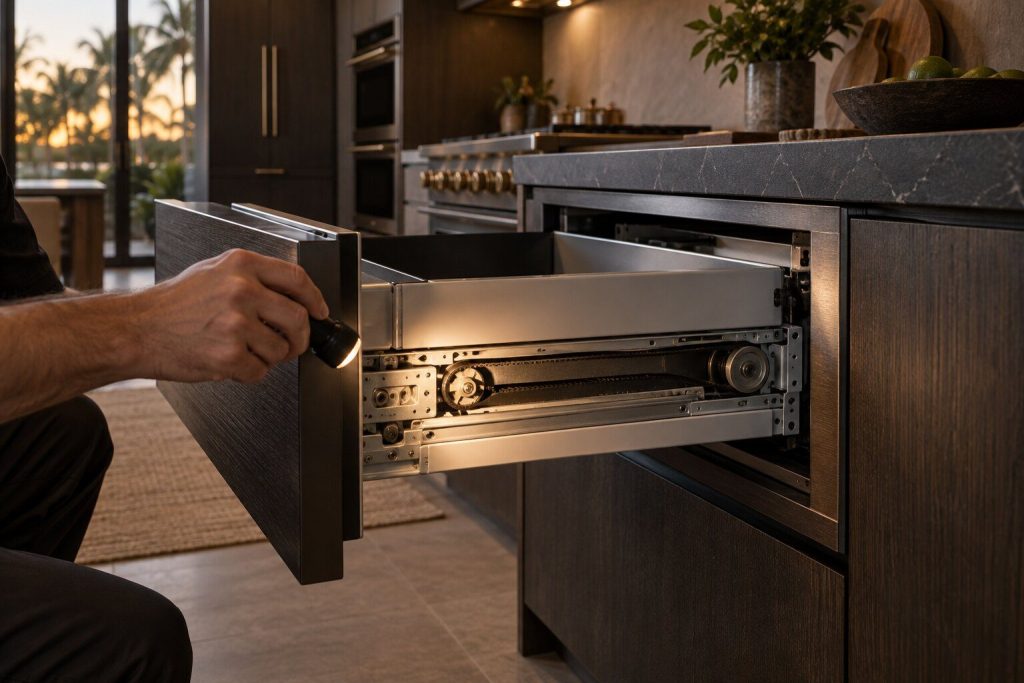
from $185 Microwave drawer mechanism
A drawer microwave is an oven and a motorized mechanism in one appliance, and the mechanism is what usually fails. A drawer that stops partway, will not open at all, or opens and immediately closes is a drive, a rail or an obstruction — and while any of that is unresolved the oven will refuse to run, because the interlock is not satisfied. That refusal reads as a dead appliance and is the machine being careful. It is a mechanical repair, it is common, and it very rarely means the microwave itself is finished.
- The mechanism fails far more often than the oven does
- A drawer that will not close leaves an oven that will not run — by design
- Mechanical repair, common, and not the end of the appliance
-
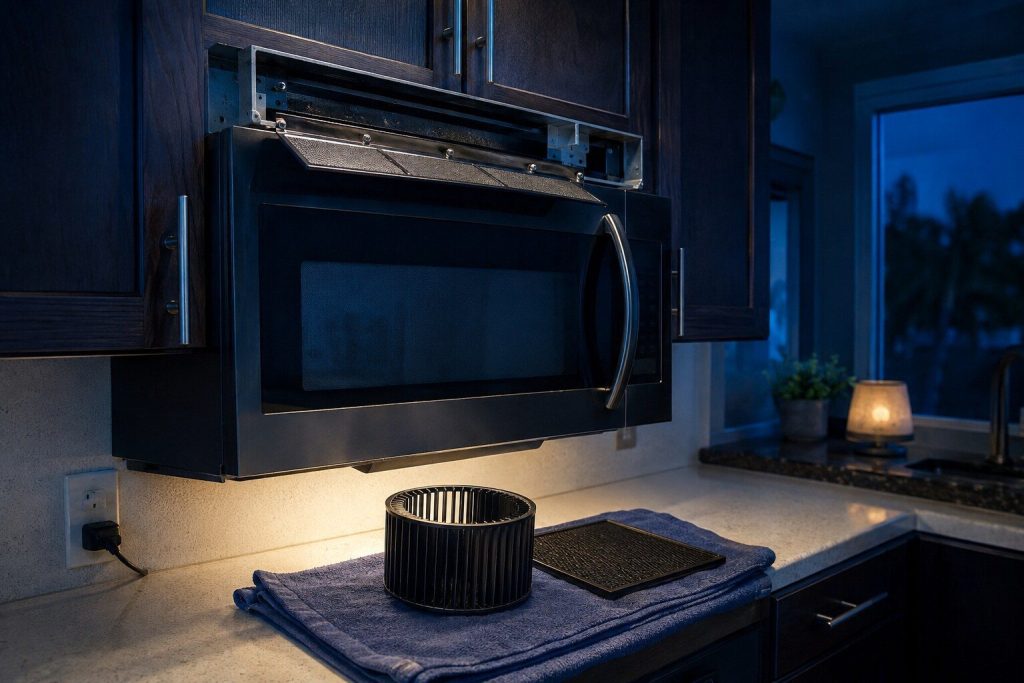
from $169 Over-range microwave and vent service
The over-range unit is two appliances in one shell — a convection microwave and a ventilation hood — and either half can fail while the other is perfect. Venting that has weakened is normally filters or the duct, exactly as on a full hood; heating problems are microwave problems. What makes this unit particular is a shared control panel, so a fan that does not respond at all and a fan that simply moves less air point at different halves of the machine. We ask which it is before the van is loaded.
- Two appliances in one shell, with one control panel between them
- No response at all and weak airflow are different halves of the machine
- Convection adds an element and a fan the plain machines do not have
-
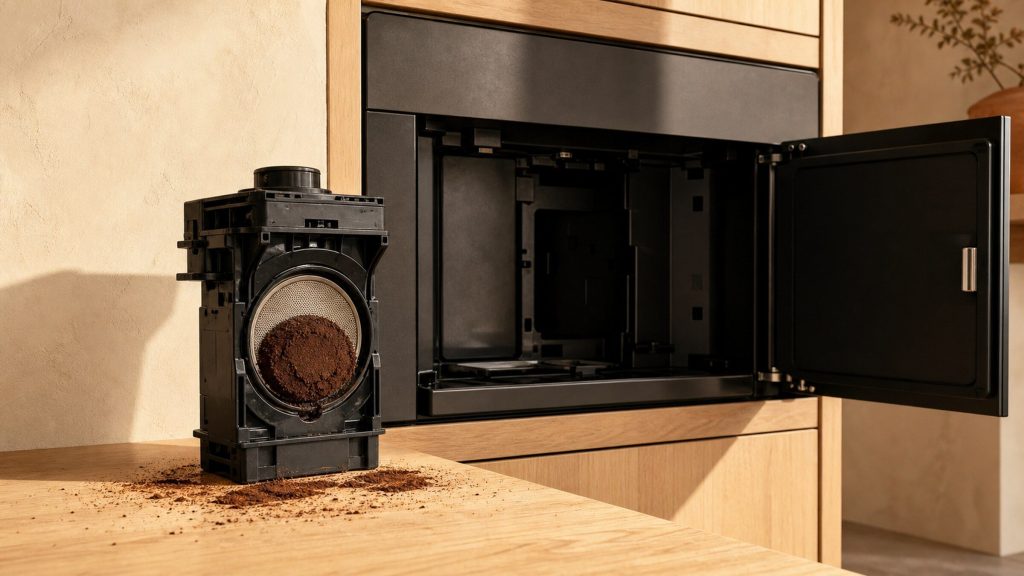
from $185 Coffee system brew group service
Coffee that has gone bitter and weak at the same time is the classic call, and it is almost always the grinder and the brew group rather than the beans or the settings. Burrs wear and the grind drifts coarse, which under-extracts; scale and old coffee oils in the group do the rest. On a discontinued platform the honest part of this service comes first: we establish that the parts exist before booking labor. Seals, burrs and the water path are the failures most likely to be solvable; boards are the difficult end.
- Bitter and weak together is grind and group, not beans or settings
- Discontinued platform — parts are checked before labor is booked
- Seals, burrs and the water path are the solvable failures
-
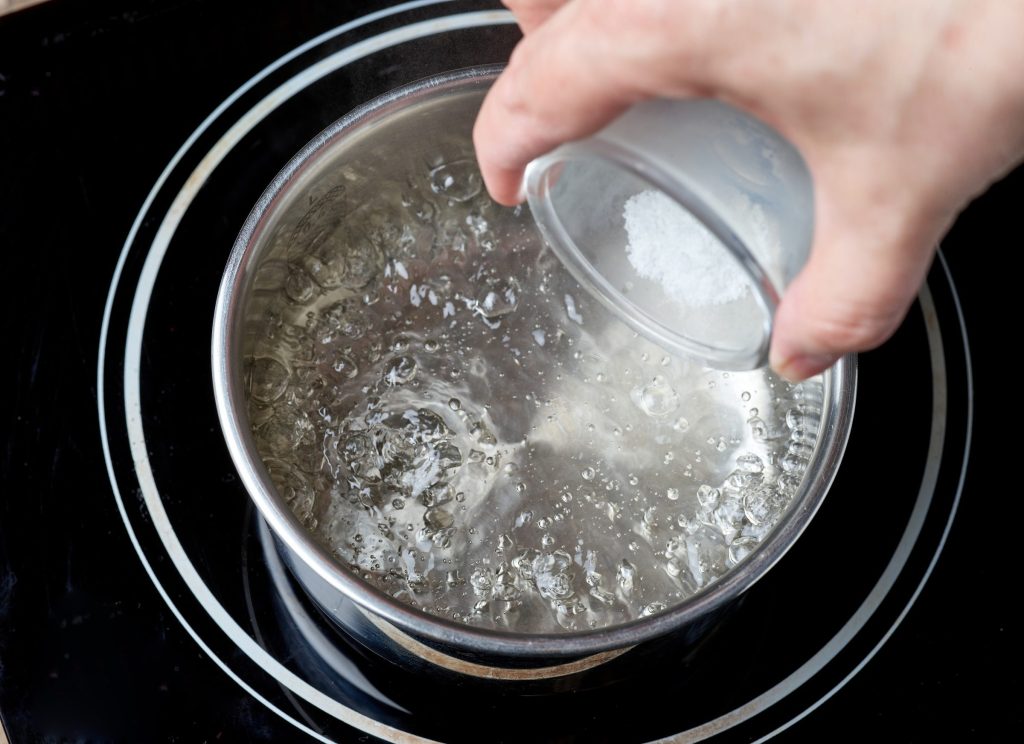
from $145 Coffee system descaling and water
Everything upstream of the coffee: the filter, the tank or the plumbed supply, and the scale that South Florida water leaves through all of it. A machine that takes longer and longer to deliver, or that has started to sound strained, is usually describing a water path narrowing rather than a pump failing — though ignored long enough, the second follows the first. On plumbed machines there is an additional reason to act early: the supply, its fittings and the drain sit behind a tall cabinet where a slow leak can run unseen for weeks.
- Slower delivery and a strained sound are a narrowing path, not yet a dead pump
- Plumbed machines hide their leaks behind the cabinetry
- Filter and descaling interval decide how long this platform lasts
-
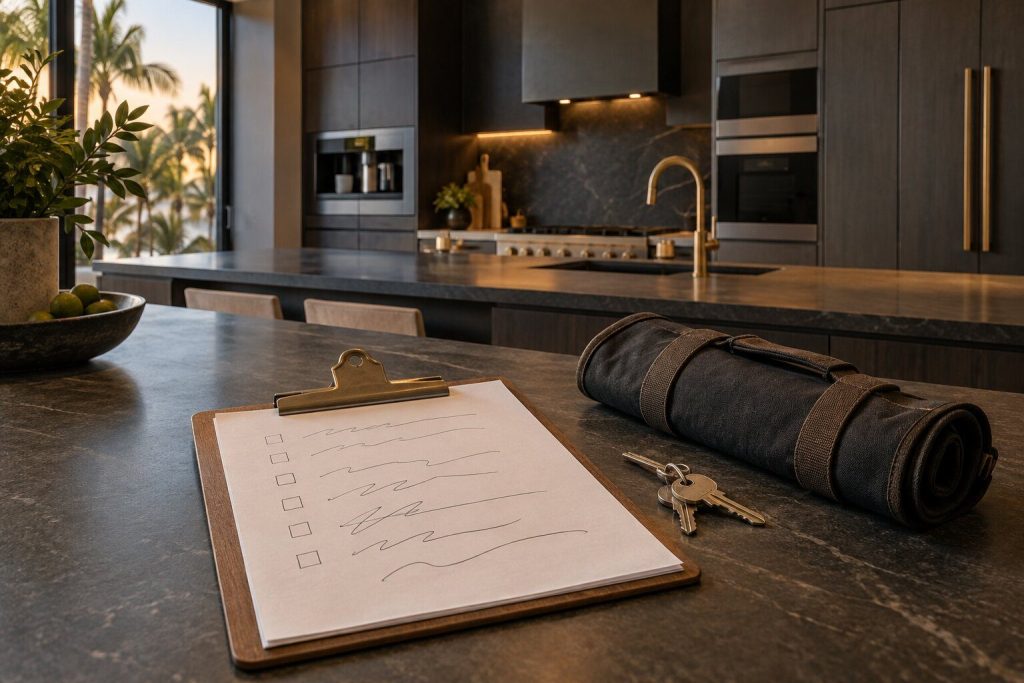
from $175 Rental turnaround service
A booked-out property with a designed kitchen has a narrow window between guests, and a Dacor in it needs somebody who will not spend the first hour working out what it is. This is one visit across the whole kitchen: every appliance run, the problems triaged by what stops a let and what merely annoys, and a written list of what was done and what is coming. Where a part is needed we say whether it arrives before the next arrival, because on a turnaround that is the only question that matters.
- One visit across the kitchen, inside the changeover window
- Triaged by what stops a let, not by what is most interesting
- A written list, and honest dates for anything on order
-
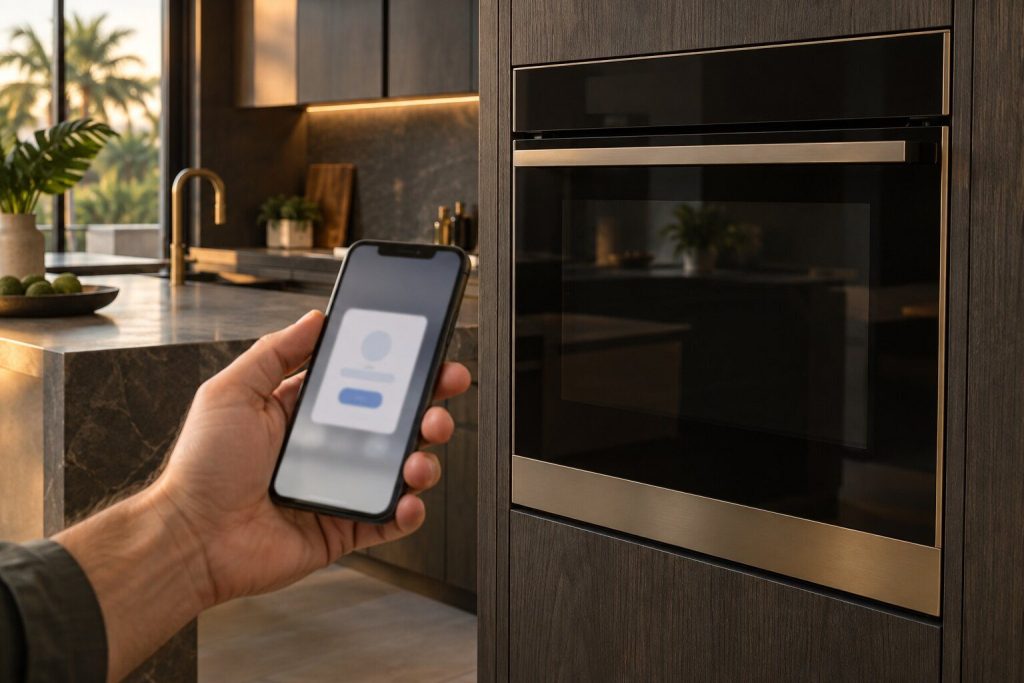
from $109 Smart features and connectivity
The current generation reports to an app, and when that link works it is genuinely useful for diagnosis — a caller who can read us what the app says shortens the conversation considerably. When it does not work, the appliance is usually fine. We treat connectivity as its own small service rather than as a repair, and we will say plainly when the problem is a router, a network band or an account rather than the machine. An oven off the network is not a broken oven, and nobody should pay for a visit that says otherwise.
- Connectivity is its own small service, not an appliance repair
- An appliance off the network is not a broken appliance
- Where the answer is the router or the account, we say so and charge accordingly
Worth saying
On a discontinued platform the parts answer comes first
The built-in coffee system was dropped after its generation and has no successor, and some legacy boards are genuinely no longer made. Where that is the case we say so before any labor is booked rather than after a visit that ends in an apology. A repair declined honestly is worth more than a repair attempted hopefully.
Before you book
The questions this page is asked
Why is the diagnostic charged at all?
Because it is the work. On this make the visit establishes two things — what has failed, and which generation of the appliance failed it — and the second is what stops a correct diagnosis buying the wrong part. It is credited toward the repair when you go ahead, and if our answer is that the machine is not worth mending you have paid for that answer rather than for a part.
Can you quote over the telephone?
We can tell you the starting figure for the job, which is on the page, and we will tell you honestly which way we expect it to move. What we will not do is give a final price for an appliance nobody has seen — on equipment that is fitted into joinery, half the estimate is the installation.
Is a legacy Dacor worth repairing?
Usually yes, and we will tell you when it is not. These are heavy, well-built machines with documented code tables and ordinary failures — igniters, sensors, relays, hinges. What we will not do is pretend every part is still available. Where something is obsolete we say so before the visit.
In more detail
How these figures were set
Researched market bands, not our own invoices
Every figure published here is what the same part and the same labor go for in South Florida, narrowed by what the part actually is on this equipment and by what the access costs in time. Nothing here is an invoice, an average of invoices, or a quote.
Three factors, written per job
Each page names three specific things that move that particular figure, and says which direction each pushes it. A set of factors that would stand on any other job is the known defect of this page type, and the builder asserts against it.
Two of them recur, and they should
Whether the appliance is captured by cabinetry, and which era it is from. Those two are the shape of this whole make, and they genuinely apply to almost every job on the list.
Not sure which of these it is?
Describe what the appliance is doing and tell us roughly how old the kitchen is, and we will tell you which page you are on. If a diagnostic is the right next step it is from $95, credited toward the repair.
This article is based on:
- Official manufacturer documentation
- Internal repair procedures
- Technician repair history
- Company quality standards