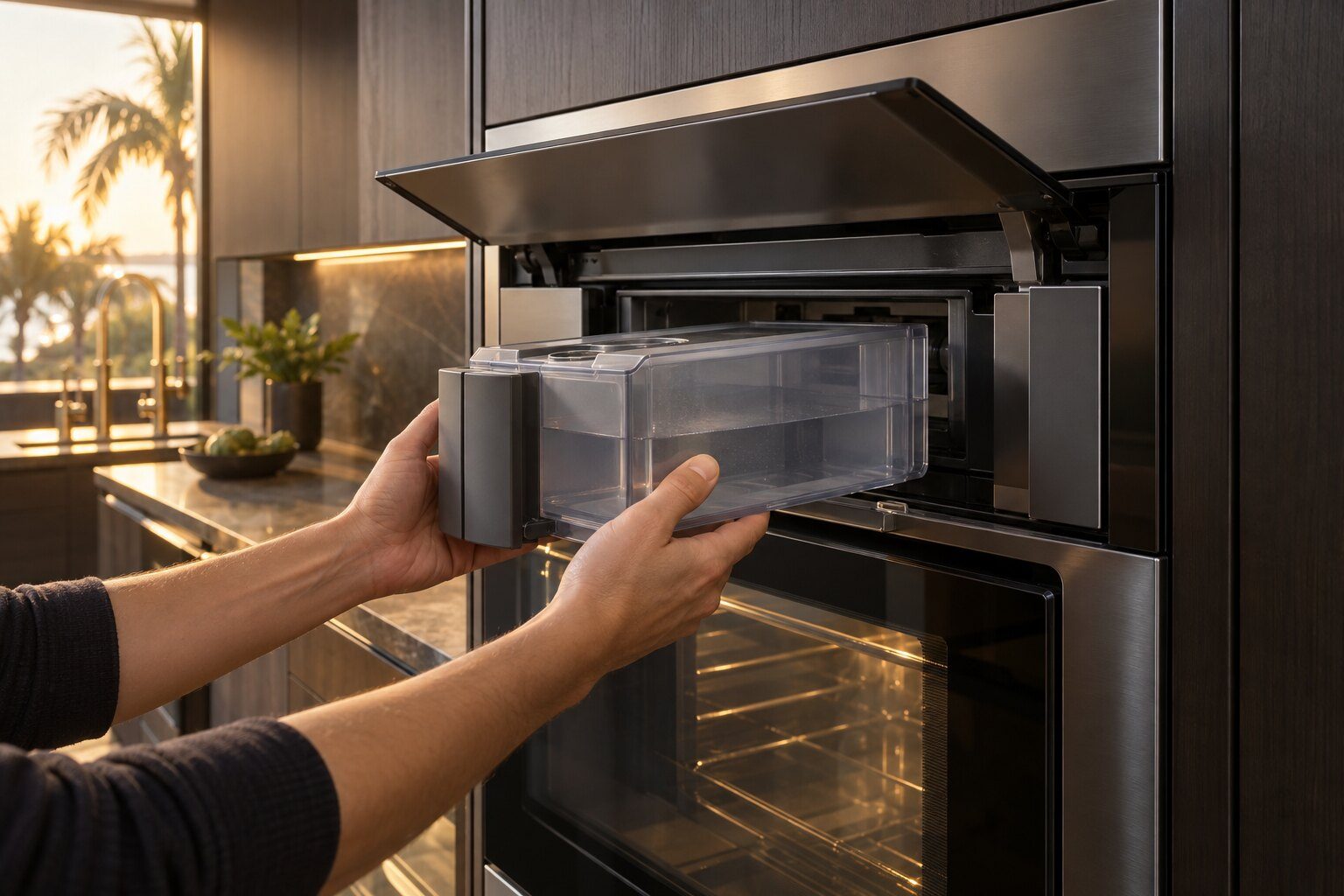
Maintenance & Prevention
The Dacor Steam Oven Descale Nobody Mentions on Delivery
Dacor's steam ovens carry a water system the plain ovens do not have: a reservoir to fill, a pump to deliver it, a path into the cavity and a descaling interval that hard water makes non-negotiable. Most problems on these are scale rather than mechanism. The early signs are a steam cycle taking noticeably longer than it used to, a pump that sounds strained, or a reservoir reporting empty when it is full because its level sensing has fouled. Descaled on schedule the system lasts well; left long enough, the scale takes the pump, and that is a considerably larger repair. On the current ovens the steam side reports C-70 and C-72 — a steam sensor open or shorted, or a drain-system problem — and those codes do not exist on the plain cavities, which is itself a quick way to tell which oven you have.
The full guide
Every steam oven arrives with a maintenance schedule and almost none of them arrive with anybody explaining it.
Dacor steam oven descaling: what the steam system actually is
A reservoir you fill, a pump that moves the water, a line into the cavity and an inlet where it becomes steam. Four things, all of them wet, all of them in contact with whatever comes out of the tap.
The plain ovens in this line have none of it, which is why so much of what goes wrong on a steam model is a category of problem the non-steam owner never meets.
What scale does, in order
First the cycle slows. Steam takes longer to appear, and because it happens over months nobody can say when it started.
Then the sensing fouls, and the reservoir starts reporting empty when it is full — which owners reasonably read as a broken tank rather than a dirty sensor.
Then the pump. It has been pushing against a narrowing path for a year and it is the part that gives up, and it is a considerably larger repair than the service that would have prevented it.
Why this coast is harder on it
Hard water leaves more behind per cycle, and a kitchen that uses the steam function several times a week runs a great deal of that water through a small system. The interval printed in a manual written for a national market is a starting point rather than an instruction here.
The codes, and what they tell you about the oven
C-70 and C-72 belong to the steam cavities: a steam sensor open or shorted, or a problem in the drain system. They do not exist on the plain ovens at all.
So a code in that pair is also a fact about your appliance — it confirms you have a steam model, which matters if you inherited the kitchen and have never filled a reservoir.
The version of this that is not a problem
A steam cycle on a machine that has just been descaled takes a little longer than usual while the system purges. A reservoir that needs filling more often in summer is doing the same work in a warmer kitchen. Neither is worth a call — what is worth a call is a trend that does not reverse after a proper descale.
What to do if it has never been descaled
Say so when you book rather than running a cycle first. A system that has gone years without attention sometimes cannot be recovered with the machine's own procedure alone, and knowing that in advance changes what we bring — and whether the pump needs to be on the van.
It also changes the honest advice. On an oven where the pump has already been straining for months, one descale buys time rather than solving anything, and it is better to know that before paying for a service that turns out to be the first half of a repair.
If it turns out to be a repair
What this leads to, and what it costs
Every job on this site is priced the same way: an on-site diagnostic first, the figure agreed in writing before anybody starts.
-
Steam oven water system
The steam models carry a water system the plain ovens do not have: a reservoir, a pump, a path into the cavity and a descaling interval that South Florida water makes non-negotiable. Most problems here are scale rather than mechanism — a pump straining, a steam cycle that takes far longer than it should, a reservoir that reports empty when it is full because its sensing is fouled. Descaled and serviced on schedule these systems last well; ignored, they take the pump with them, and that is a considerably larger repair.
- A reservoir, a pump and a descaling interval the non-steam ovens do not have
- Most problems are scale, and scale eventually takes the pump
- A reservoir reporting empty while full is fouled sensing, not a broken tank
-
Oven error code C-70/C-72
Dacor oven error code C-70/C-72: These belong to the steam cavities and they do not exist on the plain ovens, which is itself a useful piece of information: an owner who has never filled a reservoir is looking at the wrong table. Which machines can raise it, what the maker publishes about it, and what to do next.
What this one means -
Appliance maintenance
The visit that keeps a built-in kitchen out of trouble, which on this make is mostly about air and water. Columns and panel-ready cabinets breathe through grilles that joinery and rugs slowly cover; the dishwasher softens its own water and that softener has a service interval; a steam oven has a reservoir and a descaling cycle; a hood liner fills with grease where nobody can see it. None of that is dramatic and all of it is cheaper than the failure it prevents. We do the lot in one visit rather than returning for each.
- Air paths first: column grilles, condenser coils, hood filters and blower
- Water next: the dishwasher softener, the steam reservoir, the coffee system's path
- One visit across the kitchen, not one visit per appliance

Questions people ask about this
How do I know if I have a steam oven?
There is a reservoir to fill, usually behind the control panel or in the upper cavity, and a steam or combination mode on the control. If you have never filled anything with water, you almost certainly have the non-steam version — which is a whole platform of its own rather than a steam oven with the feature switched off.
Is a rinse cycle the same as descaling?
No, and that is where a good share of these problems come from. A rinse moves water through the system; descaling dissolves what has built up in the boiler, the line and the inlet. Using one in place of the other leaves the scale exactly where it was.
How often, in this water?
More often than the manual's default assumes. The appliance prompts, and the prompt is worth following rather than dismissing — on this coast the interval between prompts is doing real work.
Maintenance & Prevention
More guides like this one
-
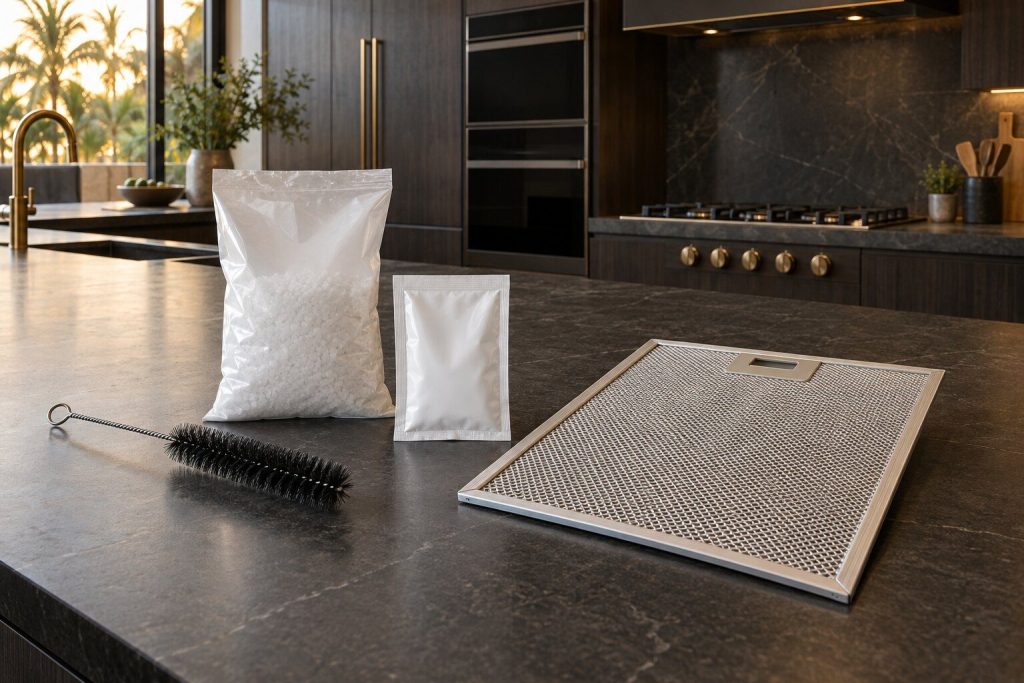
The Dacor Maintenance Nobody Hands You on Delivery
A dishwasher softener, a steam reservoir, a coffee filter and a column air path. Four items with real intervals, none of them mentioned when the kitchen was handed over, and all four decide how long the equipment lasts.
Read more -
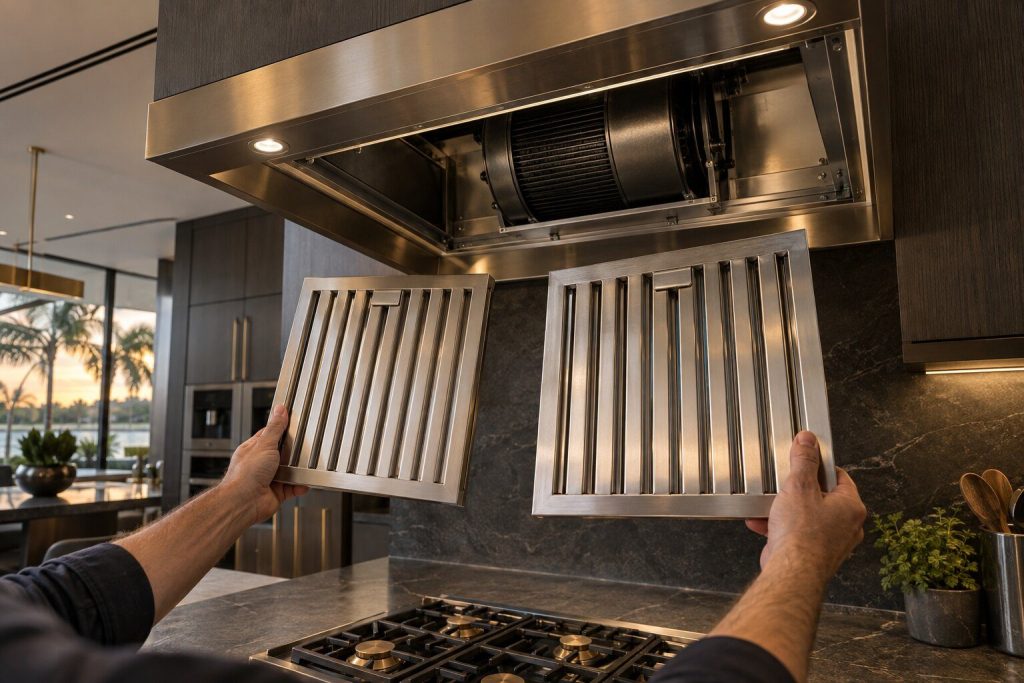
Dacor Hood Filters, Monthly: the Cheapest Maintenance in the Kitchen
Filters block gradually enough that nobody notices the week the kitchen stopped clearing. Baffles go in the dishwasher, mesh prefers hot water — and doing it monthly prevents the blower repair entirely.
Read more -
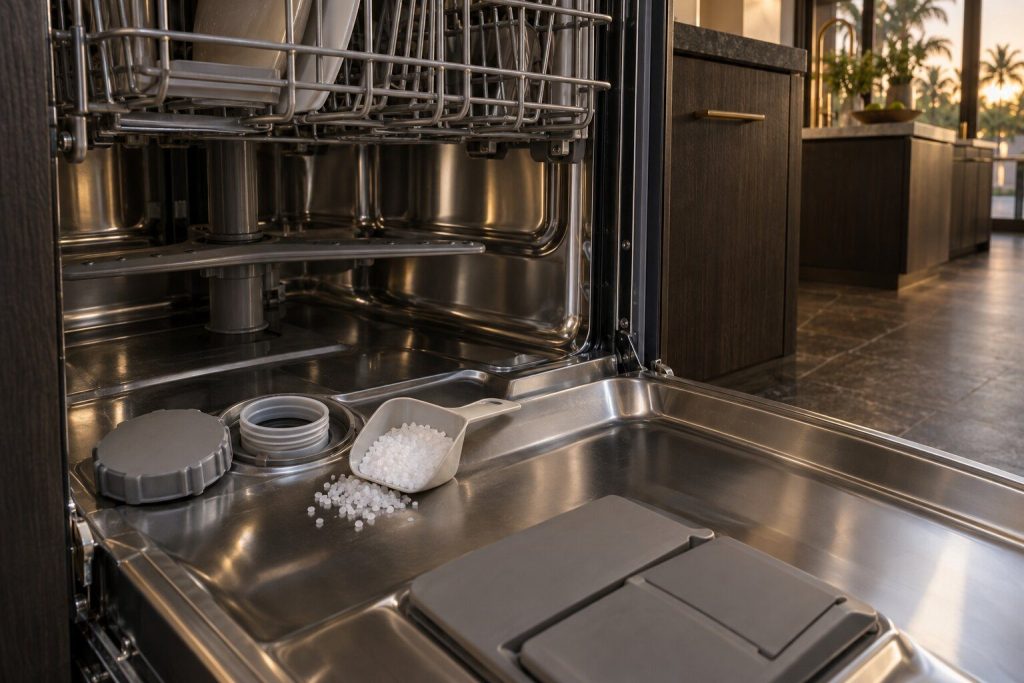
Cloudy Glass in a Dacor Dishwasher: Deposit or Etching
One glass and ten minutes of white vinegar settle it. Deposit washes off and means the water needs treating; etching is permanent and no repair reverses it — and this machine has its own softener, which is usually the answer.
Read more
Tell us the model number and what it is doing.
This article is based on:
- Official manufacturer documentation
- Internal repair procedures
- Technician repair history
- Company quality standards