Troubleshooting
A Dacor Column That Will Not Cool: Check the Grille First
A Dacor refrigerator that will not cool has four likely causes, and the cheapest one is checked first: the air path. Panel-ready columns and built-in French doors breathe through a single defined route, usually a grille at the base, and in a coastal kitchen that route fills with dust, cooking grease and pet hair. The compressor then runs continuously and the cabinet never reaches temperature — which is indistinguishable from a failing sealed system until somebody opens the grille. After that the diagnosis depends on the shape: on a French door one sealed system serves both compartments, so one warm side means the air path inside the cabinet; on a column pair the two cabinets are independent, and a cold one standing beside a warm one is evidence rather than a symptom. Dacor publishes no error code for any of this — the refrigeration reports four named alarms in an app and nothing on the cabinet itself.
The full guide
Built-in refrigeration fails in a way that freestanding refrigeration does not, and the difference is a grille.
Dacor refrigerator not cooling: why the air path comes first
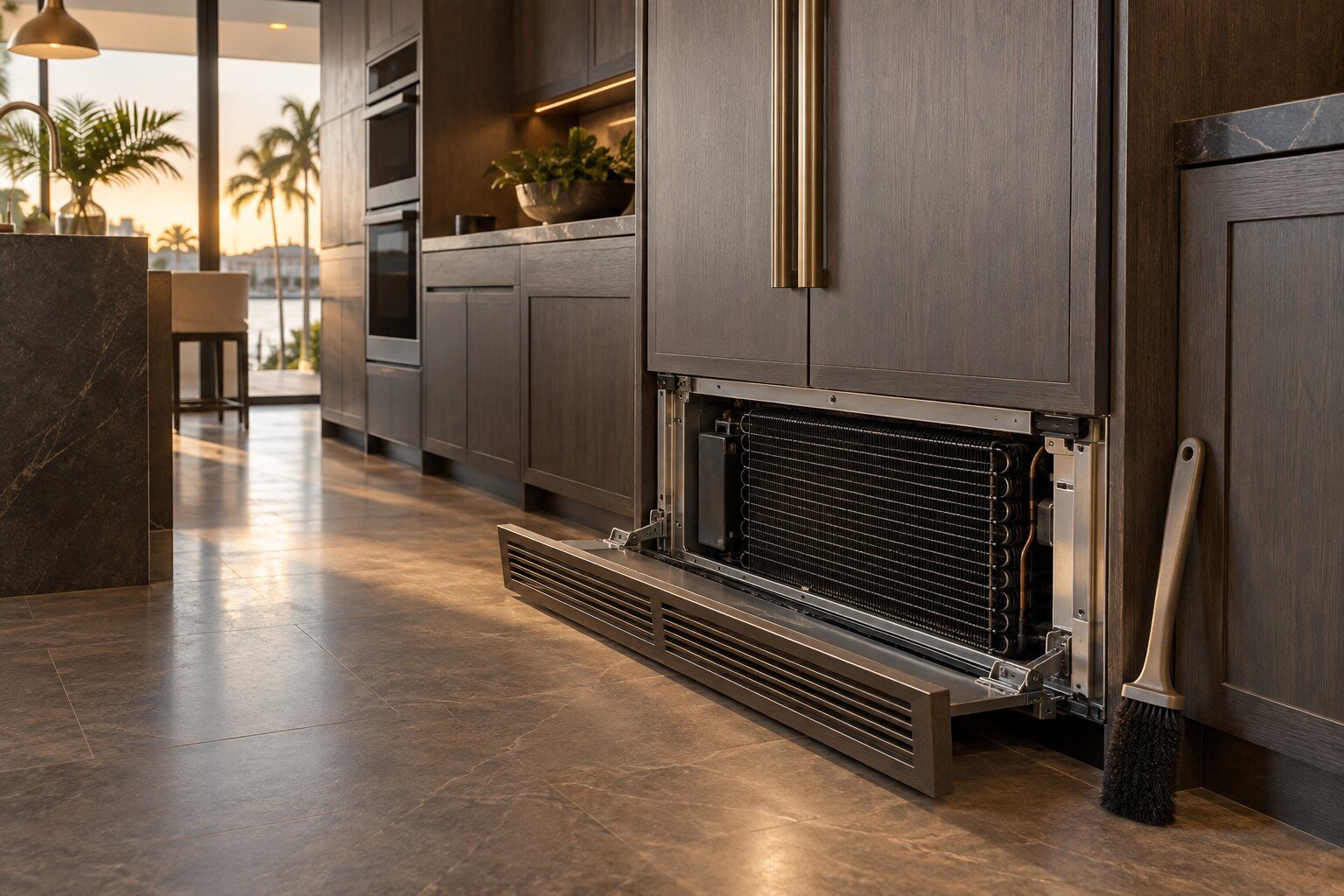
A freestanding refrigerator stands in a room and sheds heat into it. A panel-ready column is fitted into joinery, and everything it needs to do happens through one route the installer left clear — usually a grille at the base, occasionally one at the top.
That route closes up. Dust, cooking grease, pet hair and, in this city, salt air working on all three. It takes a few years and nobody sees it happening, because the grille is trim and trim is not something anybody opens.
What a blocked path looks like from the front
Exactly like a failing sealed system. The compressor runs without pause. The cabinet sits two or three degrees above where it should. Ice goes soft. Nothing sounds wrong, nothing smells wrong, and an expensive diagnosis is one telephone call away.
Two minutes with the grille off settles it, and it is the first thing we do on site for the same reason.
Then: which shape of cabinet is it
If it is a French door, one sealed system serves both compartments and air is moved between them. So a warm fresh-food side over a cold freezer points at the air path inside the cabinet — a fan, a damper, a duct closed with ice — rather than at refrigerant. That is the inexpensive half of refrigeration.
If it is a pair of columns, the two cabinets have a sealed system each. A warm refrigerator column beside a perfectly cold freezer column is not one appliance half-working; it is one appliance with a problem and another one proving that the kitchen, the supply and the room are all fine.
What to measure before anybody is called
A thermometer in each compartment, read twice an hour apart. The display is the thing under suspicion, so it is not evidence. Those four numbers decide whether the visit needs a fan and a damper on the van, a defrost kit, or gauges — three different appointments, settled before anybody drives anywhere.
What the app will and will not tell you
The current generation reports to an app, and what it reports are named alarms rather than measurements. A two-degree drift is well inside what it considers normal, which is why a screenshot saying everything is fine sits perfectly happily beside a cabinet that is failing.
The older cabinets report nothing at all. That is not a gap in this site — it is the manufacturer's own documentation, and it is why these pages are written in words rather than as a code table.
If it turns out to be a repair
What this leads to, and what it costs
Every job on this site is priced the same way: an on-site diagnostic first, the figure agreed in writing before anybody starts.
-
from $185 Refrigerator not cooling repair
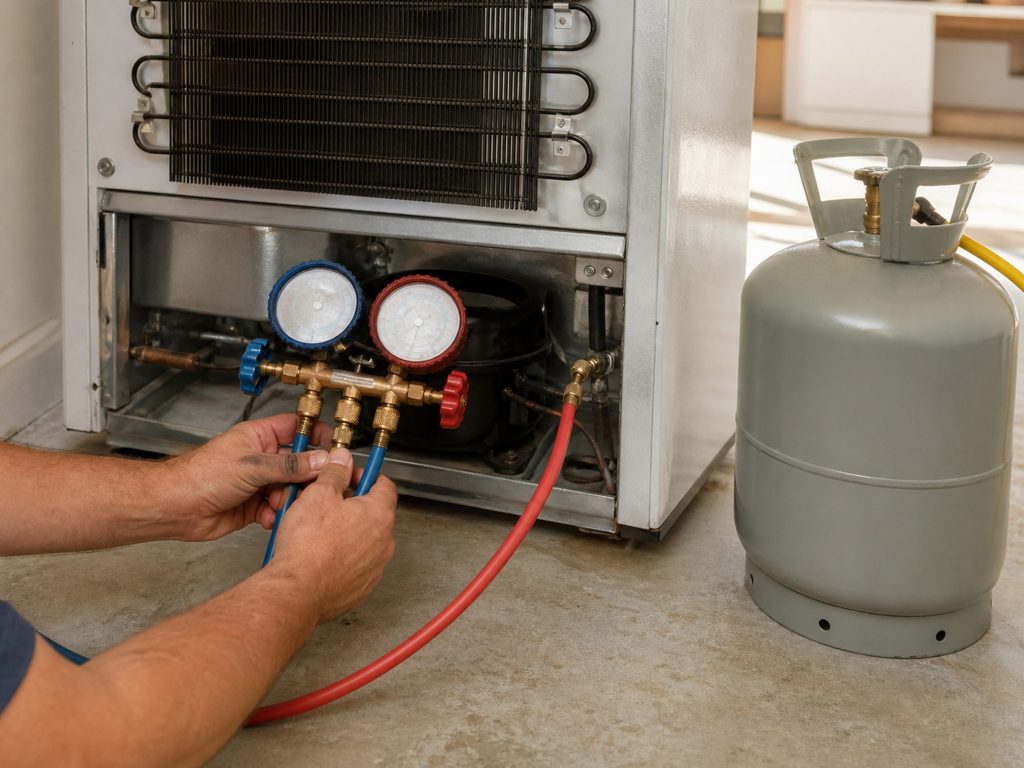
The call that covers four quite different problems, and the first job is to find out which one. On a French-door cabinet a single warm compartment nearly always means the air path — defrost, a duct, a damper, the evaporator fan — because one sealed system serves both sides. On a column it means the opposite: two cabinets, two systems, and the cold one standing beside it is evidence. Before any of that, the grille: a panel-ready cabinet that cannot breathe produces every symptom of a dying compressor while being perfectly healthy.
- The air path before the sealed system — and the grille before both
- French door and column are different diagnoses, not the same one twice
- The cold cabinet next to the warm one is evidence, and we use it
-
from $129 Condenser cleaning
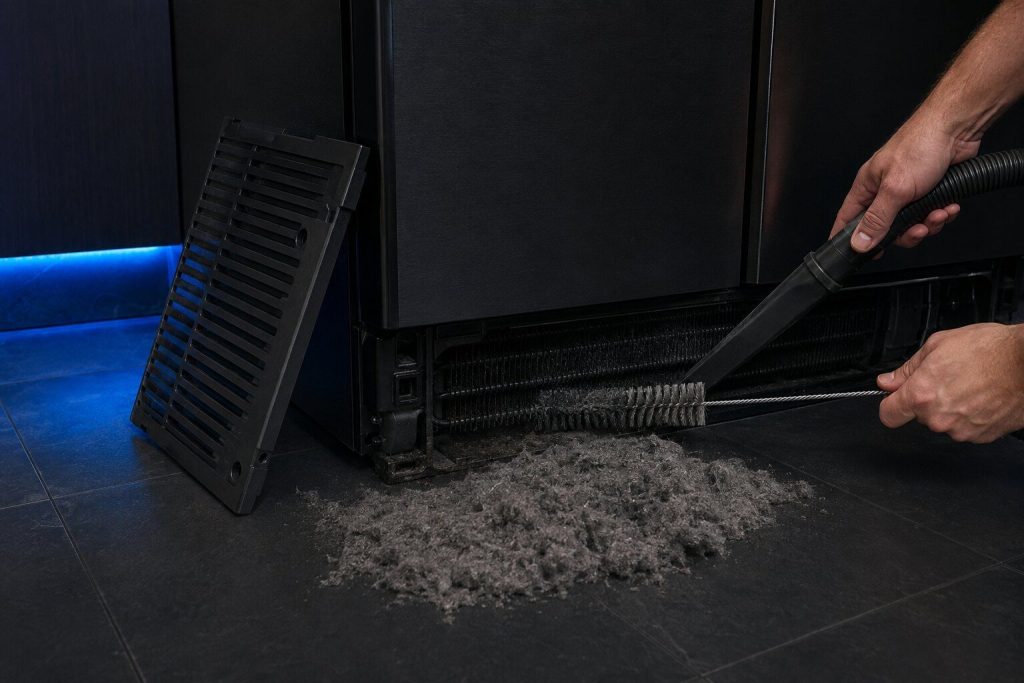
The least glamorous visit on the list and the one that prevents the most expensive ones. A condenser rejects heat, and in a Miami kitchen it does that through a grille that collects dust, cooking grease and pet hair until the cabinet is running against itself. On built-in refrigeration it matters more than on freestanding, because the coil sits in a defined air path that the cabinetry controls: when that path is restricted, the compressor runs longer, the temperature drifts, and everything downstream ages faster than it should.
- Built-in refrigeration lives on a defined air path — restrict it and everything ages
- Grease and pet hair, not dust, are what actually block a Miami coil
- Cheapest visit here, and the one that prevents the dear ones

Questions people ask about this
There is no error code. How can that be normal?
On this make it is. The manuals for the column refrigerators and the French doors document four named alarms — Self Check, Abnormally High Temperature, Door Open and Filter Replacement — and no code table at all. Sites that list 5E, 21E or 22E for a Dacor refrigerator have taken those strings from another manufacturer's list, and we do not repeat them.
Should I turn it off and back on?
It rarely helps and it costs you the evidence. A cabinet that has been running steadily can be measured; one that has been restarted is recovering, and recovering looks like working for several hours. Leave it running and take the readings instead.
How long can the food last?
A full cabinet holds temperature far better than a bare one, so leaving it loaded protects the contents. Move anything genuinely perishable once the fresh-food side passes 40 °F and leave everything else where it is.
Troubleshooting
More guides like this one
-
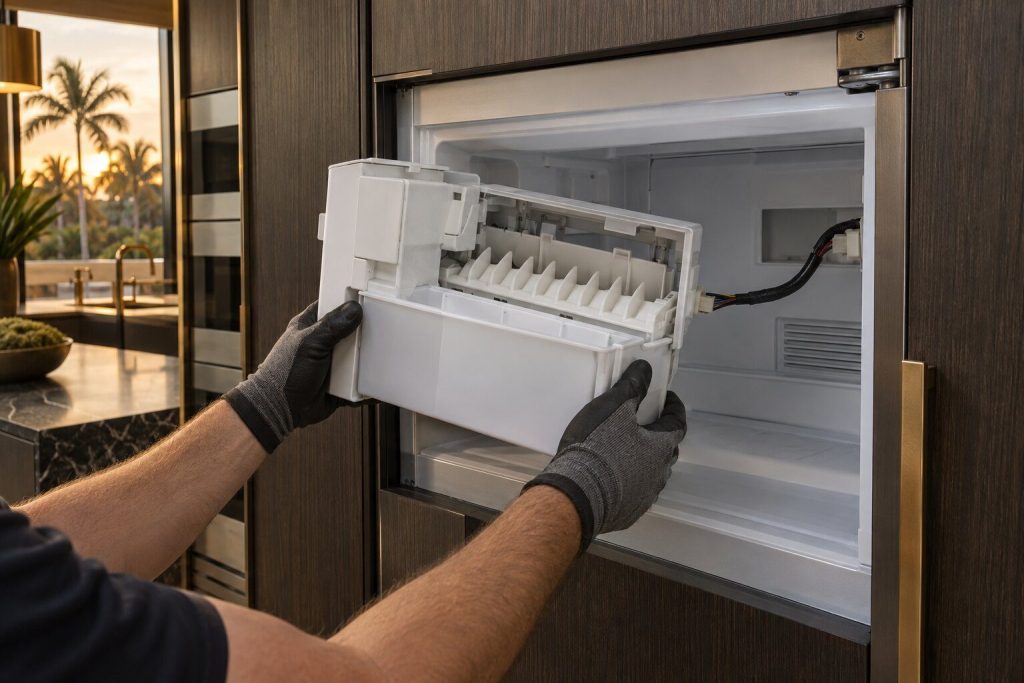
Two Ice Makers, One Water Problem: Reading a Dacor Freezer Column
The narrow freezer column carries two ice makers, and that second module is the most useful diagnostic tool in the kitchen. Both stopped is a water problem. One stopped is that module.
Read more -

The Simmer That Went Away After You Cleaned the Rangetop
The sear is perfect and the low end has gone. On a sealed brass burner that is nearly always ports, a cap seated wrong, or a simmer valve that has drifted — and it very often dates from the week the hob was scrubbed.
Read more -
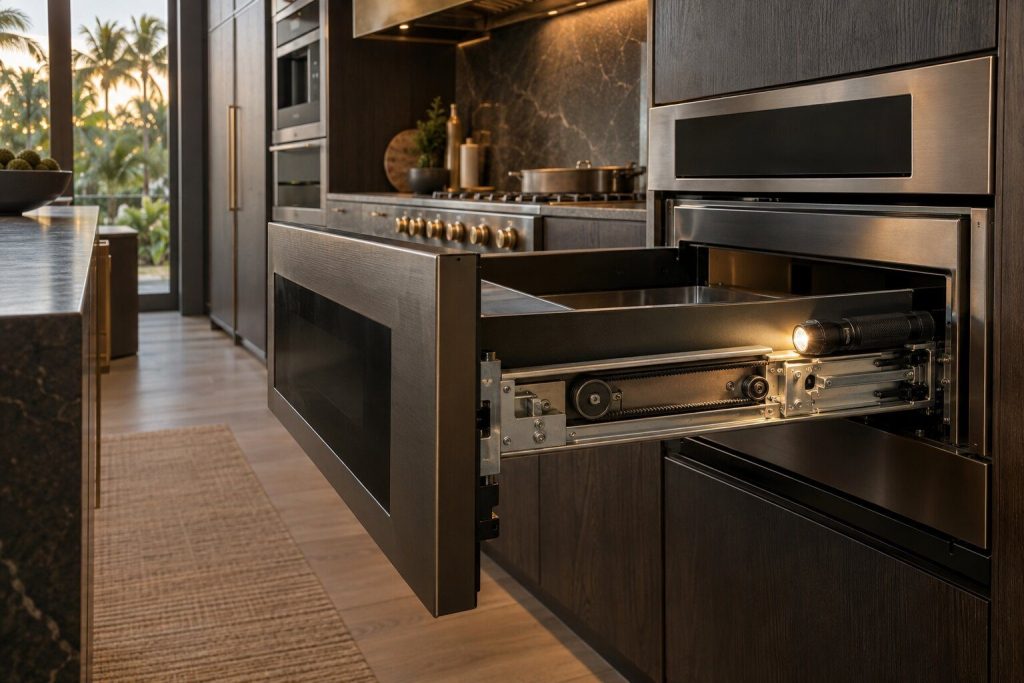
A Dacor Microwave Drawer That Will Not Open Is Not a Dead Oven
The mechanism fails far more often than the oven does, and while the drawer is not closed the oven refuses to heat — which reads as a dead appliance and is the machine being careful.
Read more
Tell us the model number and what it is doing.
This article is based on:
- Official manufacturer documentation
- Internal repair procedures
- Technician repair history
- Company quality standards